West Java Folk Tales – Princess Sumur Bandung Saijah and Adinda
by Haksan Wirasutisna
Translated to English by Innosanto Nagara
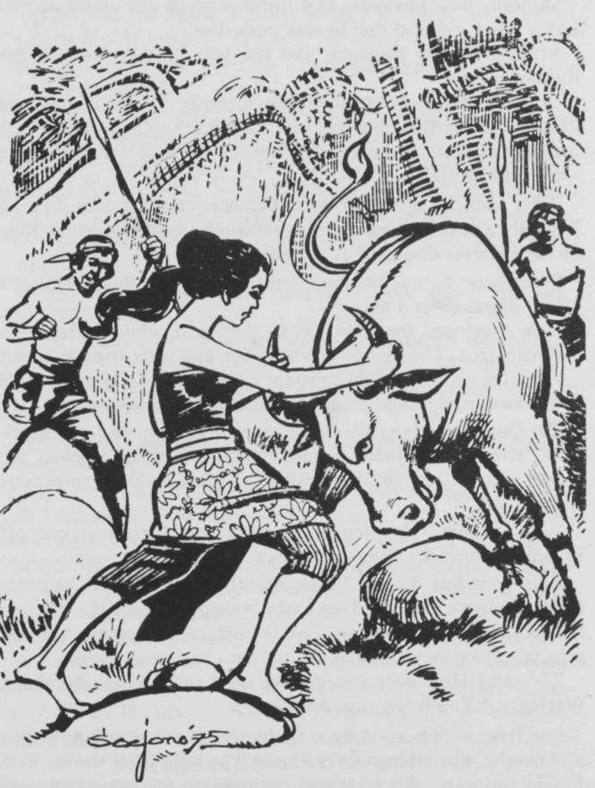
It who was only a few steps away, suddenly jumped forward
Princess Sumur Bandung
Once upon a time there was a kingdom called Kutawaringin. They say it was a great kingdom: the soil was fertile and the fields productive. Kutawaringin was a prosperous and happy kingdom. But in this world nothing lasts forever.
Day becomes night, the dry season becomes the rainy season, people are born and die, kings rise and fall. So it was with the Kingdom of Kutawaringin. When our story begins, the king on the throne was King Munding Kaling Puspa Mantri. He was famous everywhere, because he was not only strong and brave, but wise and just as well.
In war he was always on the front lines to lead and encourage his armies with his words and deeds. He treated generals and ordinary soldiers just the same: he praised and rewarded those who did well; those who made mistakes had to take the responsibility, and were punished if they were proved to be wrong. So he was loved by all his people, who looked on him as the father of the common people. But there has never yet been a perfect creature on this earth.
The brave, wise, and praiseworthy Munding Kaling Puspa Mantri had as his consort Queen Nimbang Waringin. In all the country there was no one so beautiful, like a single star shining brighter than all the others. Everyone who saw her felt, “How beautiful is the flower of Kutawaringin.” But behind her beautiful face were traits not so beautiful. The Queen was easily offended and jealous.
Once a party was held in the palace for the wedding of a princess for seven days and seven nights. As usual all the ministers and noblemen in the country came with their wives. The guests were greeted warmly and joyfully by his Majesty Munding Kaling Puspa Mantri and Queen Nimbang Waringin. When the daughter of a nobleman began to dance for the guests, the King seemed to be attracted by her, as if he were struck by her beauty.
The Queen, jealous as she was, could not fail to notice it. Nothing happened then, but later after the party the news spread that the girl who had caught the King’s attention with her dancing was summoned to the palace and scolded and insulted by the Queen. This is only one example. Even in the government of the country Queen Nimbang Waringin’s jealous character made itself felt.
When the King planned to travel around his country to see how things were going, the Queen always managed to prevent him from leaving. She was afraid he might meet a girl somewhere who would make him forget her. So the King’s work was often hindered by his wife. It isn’t sur-prising then that things began to go badly in the kingdom.
It got worse and worse until the wheels of government stopped turning altogether. Because they were not being watched carefully, in fact, were not being watched at all, the officials in the country began to behave any way they liked. They demanded whatever rents and taxes they wanted, they forced the common people to work on their fields first, and so on, making the peasants’ burden heavier. The com-mon people suffered.
Munding Kaling Puspa Mantri became dejected about the state of his country and his people. He who knew no fear on the bat-tlefield, could not face up to his own wife. It is truly said, that sometimes the power of one woman is ten times the power of a man. Finally, because he felt he could no longer control the kingdom any more, the King asked his prime Minister, Kalang Sutra, to take over.
“Dear Minister,” said the King, “I cannot bear to see my kingdom being ruined and sinking into confusion. I can no longer control the reins of government. That is why I have sent for you.” “My Lord,” replied the Prime Minister, “I wish only to do your will. But please consider this matter most carefully because it is so important.” “I have thought it over carefully,” said the King.
“I have great confidence in your wisdom, and in the other ministers as well.” “My Lord, I am ready to dedicate my body and soul to the kingdom,” replied Kalang Sutra. The Prime Minister did not want to disappoint the King. He worked hard, doing all he could so that the government would go well. He saw to it that there was supervision as there used to be, that despotic actions were forbidden so that the people were pro-tected.
At last Kalang Sutra’s honesty and diligence were reward-ed. One day he received a sign, that the kingdom of Kutawaringin would return to its former greatness and prosperity, if someone could capture a white buffalo. The Prime Minister went to Munding Kaling Puspa Mantri again. He told him about the sign he had received.
“Fine, dear Minister, announce a contest, and that the man who captures a white buffalo will be made the heir to the throne,” said the King. ‘ ‘And if it is a woman, she will become my second wife. ‘ ‘ When Queen Nimbang Waringin heard of the King’s plan, she was furious. “Women allowed in the contest?” she cried. “I forbid it!” Of course a jealous woman would fear the outcome. So women were not permitted to take part in the contest.
The news of the contest spread even to the country of Bintung Wulung. A princess of that country, Princess Sumur Bandung, was distressed that she could not take part in the contest. For no man was her match in courage of skill in weaponry. She truly wished to help the unfortunate neighboring country.
She felt it was her duty to help other human beings who suffered. She was known among her people for her advanced way of think-ing and attitude, not like the other princesses of royal or noble des-cent. Princess Sumur Bandung began by calling her two brothers, Ranggawayang and Jayamanggala. “Brothers,” she said, “Although I am a woman, I can’t find it in my heart to let the people of Kutawaringin suffer.
We must help them. Don’t you agree?” “Of course,” answered Ranggawayang, “But you are a woman. Women aren’t allowed to take part in the contest, are they? And capturing a white buffalo is very dangerous.” “You are right,” said Jayamanggala, “But let us help Sumur Bandung together.
Surely the three of us are match for such an animal? If we can just find one, we’ll see what we can do.” So Princess Sumur Bandung and her two brothers went to the jungle to look for a white buffalo. It was not an easy task, for the animal lived in a place where no human being had ever gone. There was no path, so they had to cut their way through the bushes, undergrowth, and roots that blocked their way.
Sometimes they had to climb down riverbanks so steep that they had to cling to tree trunks and hanging roots. They had to go very slowly. But finally they reached their destination. Stealthily they stalked, approaching the buffalo they sought.
Through the leaves the horns of a giant white buffalo could be seen. “There he is,” whispered Ranggawayang, pointing to an open space. “Right!” answered Jayamanggala. “Now we must not be careless for a second.” They prepared for the “ambush.
Princess Sumur Bandung moved forward stalking the buffalo from behind. Jayamanggala and Ranggawayang guarded their sister on the right and on the left. Suddenly the buffalo turned, seeming to catch the scent of the humans. But Princess Sumur Bandung was not in the least afraid.
The buffalo sensed the danger that threatened it, it lowered its head, snorting. Princess Sumur Bandung, who was only a few steps away, suddenly jumped forward. Deftly she seized the powerful animal’s horns in her hands, then she pushed back with all her strength. The buffalo would not give in.
Planting his back legs, he fought back, shaking his head to free it from the Princess’ grasp. Gradually the buffalo’s strength gave out; his breath came in gasps, his snorting faded, finally, panting, he gave up. Skillfully Ranggawayang and Jayamanggalla tied up the animal with a stout rope, so that he was powerless. Princess Sumur Bandung and her two brothers set out for Kutawaringin.
Imagine the meeting of Prime Minister Kalang Sutra and Princess Sumur Bandung. He was thankful that the white buffalo had been caught, but he was also worried, because it was a woman who had captured him. After some thought, the Prime Minister said, “Let us do this! The only way is disguise.
Let the buffalo be presented to the King by the Princess disquised as a man.” So Princess Sumur Bandung went to Munding Puspa Mantri’s palace disguised as a man. How overjoyed the King was to see that a white buffalo had been captured. The shadow of confusion and suffering which had covered the country would be swept away; the country and people of Kutawaringin would enjoy a brillant age once again. But Queen Nimbang Waringin, being a woman, had a presenti-ment.
Even with Princess Sumur Bandung’s clever disguise, the Queen was not easy to fool. Jealous people are always suspicious and distrustful. With certainty she stepped forward and fiercely jerked off Princess Sumur Bandung’s false hair. King Munding Kaling Puspa Mantri and the court servants about him were amazed.
They had not suspected that the warrior, the conquerer of the powerful white buffalo was actually a lovely princess. How they admired her for her courage and skill. “Wretch! How dare you deceive us!” cried Queen Nimbang Waringin.
“You’ll feel my revenge!” She flew at Princess Sumur Bandung. They scratched, kicked and fought. Everything was confused.The fight grew worse. Both fought furiously.
But what was the strength of Queen Nimbang Waringin compared to the strength of the giant white buffalo? Eventually the Queen seemed to weaken. She fought less strongly. Seeing this, the Prime Minister could not just go on watching.
He came forward to help the Queen, who had almost given up. Of course Jayamanggala, Princess Sumur Bandung’s brother could not let that happen. He went forward to stop the Prime Minister. Then a terrible contest took place.
The palace was thrown into confusion. The women had stopped fighting, but the battle which took its place was even more violent. For the Prime Minister and Jayamanggala were evenly matched in strength, skill, and wisdom. They were each defending their honor.
Neither would give in, and neither could win. Princess Sumur Bandung was anxious and frightened. Who could stop them? “I must go to my grandfather in Kahyangan,” she thought.
“Only my grandfather can help me in such difficulties.” So Princess Sumur Bandung went to Kahyangan, the home of Sunan Ambu and the other gods. Queen Nimbang Waringin watched her leaving suspiciously. Then she swiftly followed her. When Princess Sumur Bandung and Queen Nimbang Waringin knelt before Sunan Ambu, he spoke softly, “My grandchildren, listen carefully to what I say.
I heard you fighting in the palace of Kutawaringin. For what reason? Because of rnisunderstanding and ignorance. Sumur Bandung honestly wanted to help and rescue Kutawaringin from disintegration and suffering.
But she was wrong to pretend to be a man. And you, Nimbang Waringin, were also wrong because of your jealousy. Your excessive jealousy caused the country’s confusion and the people’s suffer-ing. While all the time ….” Sunan Ambu paused for a moment.
Princess Sumur Bandung and Queen Nimbang Waringin listen-ed carefully. “Actually … you two are cousins. Now, you must shake hands and ask each other’s forgiveness!” Princess Sumur Bandung and Queen Nimbang Waringin were could not finish the work on his rice paddies, and no paddies would mean no rice, hunger, and not being able to pay taxes.
Saijah Adinda
So with a heavy heart he sold his dagger in the city for twenty-four rupiahs. It was enough to by a new water buffalo. At that time Saijah was seven years old. He was still a child. He loved the new water buffalo his father bought.
He took good care of it. Every evening he groomed the water buffalo’s grey hide with a bunch of leaves or grass until it shone. There was always fresh grass in its pen that he cut in the field outside of the village. Sometimes he talked to the animal as if it were a human being.
So naturally they became good friends. Saijah loved the water buffalo and in return the water buffalo loved Saijah. Saijah’s father’s rice paddies were next to Adinda’s father’s rice paddies. Saijah’s father and Adinda’s father had agreed that the little girl was later to marry Saijah.
That was the custom in the old days in Indonesia. When Saijah saw Adinda’s brothers and sisters they would call to each other and joke, or praise the strength of their water buf-faloes. How happy they were! Days, weeks, and months passed.
Saijah was nine years old and Adinda was six. But the District Head had not changed. He was still greedy and did whatever he wanted. He wanted Saijah’s father’s water buffalo again and like before he took it without paying for it or giving anything in return.
He stole it. For the second time Saijah’s father’s tears fell. For the second time he sat sadly for hours and hours. All he could do was sigh.
Saijah, who loved his water buffalo so much, cried for a long time. He did not want to eat or drink. He felt that his throat was stopped up. “Father, did you see our water buffalo in the city today?
Was he still alive?” asked Saijah sadly. Saijah’s father did not answer. He looked confused and sad. He was thinking about how to get a new water buffalo.
The only heirloom they had left was a mosquito net holder given to Saijah’s mother by his grandmother. What else could he do: so that they could have rice paddies, he sold it for eighteen rupiahs. Now for the second time Saijah’s father bought a new water buffalo, but it was not as good as the one before it. After a while Saijah began to love his new water buffalo.
Even though it was not as good as the one before, it had a whorl of hair on its shoulder and people said that that was a good luck sign. One day when Saijah was in the rice fields he had a frightening experience. He was riding the water buffalo when it suddenly stop-ped. Saijah was surprised and he cried out, “Come on, let’s go home!
Hurry up! Hurry up!” But this time the water buffalo would not obey. Saijah swore at him, but the usually tame and obedient animal would not move a step from where he stood. Saijah got angry.
He kept hitting the animal with a piece of bamboo. Suddenly he heard his friends cry-ing, “Run! Run, Saijah! There’s a tiger!” All the children quickly slipped off their buffaloes’ yokes and then jumped back on them and ran away through the paddies, past the dikes, mud, and bushes towards the village.
As quick as a wink Saijah slipped off his buffalo’s yoke and jumped on his back. But just at that moment a tiger sprang out of the bushes. Because he was so startled Saijah lost his balance and fell. The water buffalo was going so fast it ran a few meters past Saijah.
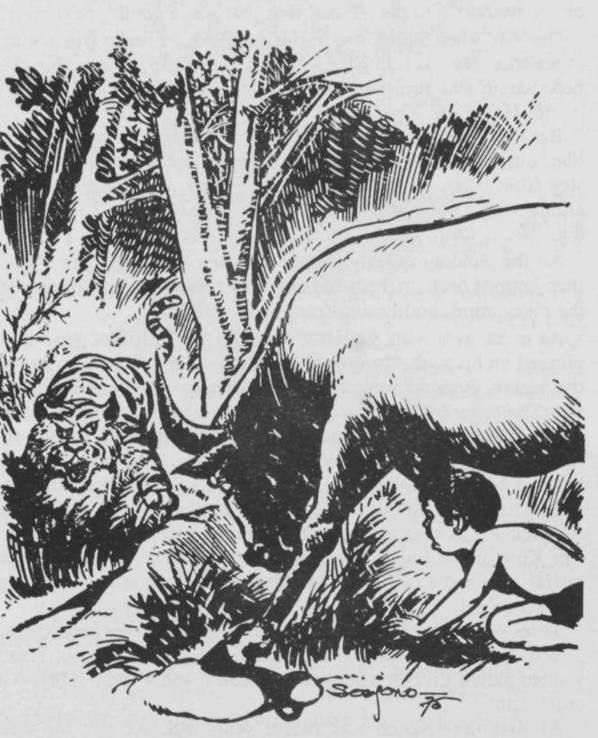
tiger
But when it saw that its master was in danger, it stopped, turned around and stood ready over Saijah, guarding him with lowered head. Growling, the tiger lept, but the buffalo skillfully caught its enemy with its sharp horns. The tiger snarled in pain. Its stomach was pierced by the buffalo’s horns and blood poured out.
The King of the Jungle fell, kicked for a moment, and died. The buffalo too had a cut on its shoulder, but it was not bad. Saijah’s life was saved. Three years passed.
Saijah’s water buffalo was three years older. It was fatter and stronger. But again, the greedy District Head wanted Saijah’s father’s buffalo. He stole it and killed it.
He was a cruel man! At that time Saijah was twelve years old. Adinda too had become a pretty little girl and good at weaving and making batiks. Weaving and making batiks were the main things little girls had to learn to do in those days.
But because she was sad seeing the things that happened to Saijah’s father, her batik patterns always looked dark and sad. How unhappy Saijah’s father was. Saijah’s mother was even sadder. She had tended the water buffalo’s cuts after it saved Saijah’s life.
But after it was well, Saijah’s protector was stolen and killed. From sadness and worry she became sick, and finally died. Saijah’s father lost hope: his wife had died, his water buffalo was gone, he had nothing left to sell. He was afraid because he could not pay the taxes.
He did not dare to stay in his village. One day he secretly walked away from Badur trying to get to Bogor to find a job. But it seemed that he was born to be unlucky and to suffer. When he got to Bogor he was caught and because he did not have any travel papers he was sent back to the place he came from.
Maybe because he had suffered so much he began to lose his mind, and he was put in jail. But he did not have to suffer much longer, for soon after he fell sick and finally Saijah’s father died in the cold jail cell. When Saijah’s father went away, Saijah was fifteen. He did not want to go to Bogor because he had another plan.
Once he had heard that in Betawi (now called Jakarta) there were many Dutch-men who had carriages. The kind of carriages they had were two-wheeled and pulled by horses. Footmen stood in back to balance them. This job could be trusted to a young boy.
If he was good, hardworking, and honest, he could get good pay. If he saved his money carefully, maybe after three years he would have enough to buy two water buffaloes. With a firm will, Saijah went to tell his hopes to Adinda. “Dinda, when I come back we’ll be old enough to get married, and we’ll buy two water buffaloes.” “I hope so, Saijah.
While you’re gone to the city I’ll work hard spinning and weaving sarongs.” “I trust you Adinda. But I’m only afraid that you’ll marry someone else.” “Oh, you still don’t believe me? I promised not to marry anyone else. Wasn’t that the promise between your father and mine?
And what about you, Saijah?” “Don’t worry, Dinda. I’ll come back and marry you. When I come back, I’ll find you.” Saijah stopped and thought for a mo-ment and then said, “It would be better if I waited for you under the ketapang tree at the edge of the forest.” “But how will I know when you come back?” Saijah thought for a while and then answered, “Like this, Adin-da. Count the months.
I’ll be gone three times twelve months. For every new month make a cut on your rice mortar. When you’ve made three times twelve cuts, the next day I’ll wait for you at the ketapang tree. I’ll wait for you there, Dinda!” “All right, Saijah.
I promise to wait there. I hope all your plans will work out!” As a token of his promise, Saijah tore off a piece of his old headband, and gave it to Adinda. And Adinda gave him some jasmine flowers to remember her while he was gone. The next day Saijah left, his heart heavy at leaving the place where he was born.
He passed by the city of Rangkasbitung, for his destination that day was Pandeglang. After resting there, he went on to the capital, Serang. How amazed he was to see so many stone houses with tile roofs. In his village there were no houses like that.
In Serang he rested and when the sun was setting he went on to Tanggerang. For the first time Saijah felt sad and homesick. He longed to see Adinda. Then he took out the package with the jasmine flowers she gave him when they parted.
His sad heart felt a little happier. He wanted to go home, but then he remembered his plans. Hadn’t he promised to marry Adinda and buy two water buffaloes? What would Adinda say if he came back without anything?
Adinda would make fun of him. No, he had to go on and not come back until he had done everything he planned. Saijah had new confidence. He was not going to give up.
He walked faster so that he would get to Betawi sooner. He was lucky and quickly found work as a stable boy for a Dutch family. He was a good worker and everyone liked him. From a stable boy he became a servant in the house.
He got more pay and he wore clean, fine clothes. He had changed. But he never forgot his plans and his promise to Adinda. So after he had worked almost three years, he asked to leave.
His mistress was surprised and asked, “Why are you stopping? Don’t you like it here?” “Oh no, I miss my home and I promised to marry someone there before I left,” answered Saijah. “All right, then,” replied his mistress. Saijah got travel papers and recommendations.
Then he got ready to go back to Badur and Adinda, whom he had left for three years. How happy Saijah was. He was going home to where he was born. He walked so fast it seemed his feet had wings.
While he walked he counted up all he had. In one bamboo container he had his papers. In another tied to his belt he had thirty ringgits. How heavy that much money was!
Enough to buy three water buf-faloes. He had a dagger in a copper sheath covered with silver. And still another thing: a wide pendant with a gold chain, … a present for Adinda! And finally in a small silk bag he had the dried jasmine flowers.
He did not notice the places he passed. All he thought of was Badur, and Adinda. He wanted to get there as fast as he could. He remembered the days when he was young, playing in the rice pad-dies and fields with Adinda’s brothers and sisters.
He imagined Adinda, a slim village girl, with black hair and sparkling eyes. Saijah did not feel tired. He walked on, rested a moment, then walked on again. When the moon began to rise he could see the teakwood forest far away.
Tomorrow I will see Adinda there, thought Saijah. He walked faster. In the dim moonlight he looked for the ketapang tree. Under that tree Adinda had given the jasmine flowers to him to remember his promise to her.
He sat under it watching the stars and the moon. He sat there for hours. He did not feel the time passing. The sky began to get lighter.
The sun came up slowly. Patiently Saijah waited. Adinda did not come. He was still pa-tient.
Had she forgotten her promise, or was she just late? Maybe, thought Saijah. The day got lighter. Adinda still did not come.
Saijah lost his patience. He could not wait any longer. He stood up suddenly and ran to the village. The village people recognized him and called out, “Saijah!
Sai-jah!” But it was as if he did not have ears. He ran on to the end of the village looking for Adinda’s house. He could not find it. He ran back but it was no use.
Saijah was like someone who had lost his mind. He stopped and held his head in his hands and cried, “I’m going crazy! I’m going crazy!” Of course Saijah could not know that Adinda’s house was not there any more. Since the District Head took Adinda’s father’s water buffalo, she had gone along to Cilangkahan on the West coast of Banten.
Adinda’s father and the whole family had left with some other people because they could not pay their taxes. Then they took boats and crossed the Sunda Strait towards Lam-pung. All this happened while Saijah was in Betawi. An old woman who felt sorry for Saijah took him into her hut.
There she took care of Saijah. He.got better but people were sur-prised to hear him shout, “I don’t know where I’m going to die! I don’t know where I’m going to die!” One night when there was a full moon Saijah went out quietly. He looked for the place where Adinda’s house used to be.
It was hard, for it had fallen down long ago. Over and over he tripped over old pieces of bamboo on the ground. He found the bamboo cot Adinda used to sleep on. That was all that was left of the house of the girl he loved.
The next day Saijah asked for help to find Adinda’s old rice mortar. The mortar now belonged to someone else. Without say-ing anything he counted the cuts on the mortar. There were … 32.
So it lacked only four cuts. That meant that Adinda and her family had left four months ago from Badur. It turned out that Saijah was not rally crazy, for he thought about the old woman who had taken care of him. He gave her enough money to buy one water buffalo.
And then he bought a small sampan. With that sampan he crossed to Lampung to look for Adinda, for he still had some hope. At that time the situation in Lampung was very dangerous, for people from Banten who had escaped to Lampung were rebelling against the Dutch East Indies Government. One day Saijah walked by himself into a village that had just been burned by the Dutch army after they cleared out the rebels.
He walked into a house that had only been partly burned down. Suddenly his foot touched a body. He looked at the body. It was the body of Adinda’s father.
Next to him were the bodies of three of Adinda’s cousins, and not far from them was a fifth body. Sai-jah began to tremble, for it was Adinda, whom he had searched for, for so long. On her chest was a deep wound. Saijah had no more hopes.
Nothing meant anything to him any more. His father, mother and all his relatives were gone. Now Adinda, the only person he loved, lay dead. Saijah did not care about his life any more.
He fought the Com-pany soldiers bravely. He was not afraid of bayonet, knife, or musket. With all his might he pressed his chest against the bayonets until they pierced his chest. Soon afterward he died.
That was the end of Saijah’s story. This is one of the stories which reminds us about the bitterness and cruelty of that colonial period.
Sumber Resmi:
INDONESIAN FOLK TALES
BALAI PUSTAKA STATE PUBLISHING AND PRINTING HOUSE BP No. 2993
All rights reserved First published in 1981
Perpustakaan Universitas Leiden (Leiden University Libraries) – Koleksi Digital (Digital Collections)
https://digitalcollections.universiteitleiden.nl/view/item/129019