Berjalan bersama sahabat mencari kebaikan.

Month: October 2026 (Page 1 of 4)

Indonesia Folks Tale – AMAN JEMPRET Aceh – in English

AMAN JEMPRET

Even before dawn had broken, Inen Jempret was usually half-way through her way to the rice-mill, that lay some distance from her house. Usually she carried a basket in her hand and a sack under her arm. She always crossed the dikes between plots of land wit quick steps. Sometime she would have to jump over a gutter, and this she did with the expertise of long practise.

By the time the sun had climbed out from behind the eastern hills, she was already on her way back towards home carrying with her the broken bits of rice that she had gathered from among the piles of husk left behind from the rice that had been threshed the day before.

This was what she and her husband Aman Jempret ate each day. They were very poor. They possessed no land at all apart from the plot on which their broken little house stood.
aman jempret

Aman Jempret

They didn’t just feel poor because they didn’t have land, after all, they were still holding their body and soul together, they still found something to eat, no matter what terrible hardships they underwent.

But their worst affliction was solitude. They could find no way to fill their loneliness. They had no children, no one to shower their affection on, and no one to look up to for support in their old age. Indeed no one to turn to even now. For years they had accepted this as the will of God”.

They had long carried with them this sorrow of unfulfilment. They had learnt to be patient and hadn’t allowed despair to overshadow their lives completely. When Inen Jempret returned with the rice each day, her hus-band was out of the house. In fact, he used to leave the house soon fter she did.

With a fish-trap on his shoulder, he went each day to the little river nearby. There he sunk his fish-trap and sat fishing through the day. On the way back he’d picked handfuls of leaves from the rows of edible fern, to have as vegetables along with the fish he had caught.

Usually Inen Jempret prepared a dry mixed vegetable dish with the fern leaves, and the fish was dried too. This was the cou-ple’s most favourite food. One evening after having filled himself with the dried vegetables, Aman Jempret spoke to his wife.

“Inen Jempret,” he said tenderly and thoughtfully.

“Yes,” his wife answered carelessly from behind the kitchen wall which separated them. During the day time Inen Jempret would use this kitchen to cook their meals, in the evenings it was the place where they warmed themselves.

“I have a special plan for tomorrow.” Inen Jempret sat silent, not in the least interested in what Aman Jempret had to say.

“I am not going to the river tomorrow. I have other plans.” He explained what he had said before since he realized that his wife wasn’t paying any attention.

“What plan?” she asked coldly.

“When I was coming home this afternoon, I thought of something.”

“Don’t you plan and think too much, Pa …, you’ll forget to bring back food.”

“Don’t you worry about that. You see, in the place where I fish there are some large trees ….”

“So?” Inen Jempret snapped.

“I want to tie my fish-trap to the top of the tree.”

“My God! You must be going mad,” she said in annoyance.

“Oh …, sorry, forgive me. Inen Jempret, I do mean to get some catch.”

“And pray, what fish is it, that swims in the air on top of those trees? You’re crazy!” She said angrier than ever.

“You can call me mad now, but I do hope to get some thing back.” He said softly, not wanting to annoy his wife any more.

They fell silent. Early next morning Aman Jempret cut out pieces of bamboo and tore them into shreds of about the width of the little fingers. These he strung on to ratten, to form a cone.

Then he left the house without bothering to say goodbye to his wife. Inen Jempret who watched the whole thing was so irked by it that she could say or do nothing, apart from helplessly shaking her head as she watched her husband leave.

She was afraid that her poor husband was getting somewhat senile in his old age! Perhaps this was bound to be, she thought, for so many problems bothered him all the time. What a scandal it would be, if the people of the village found out what her husband was up to!

How embarrassing it would be, if the people around, discovered that Aman Jempret had taken to fishing on top of trees. People would say: “No wonder! But oh …, it is so sad.” Thus thought Inen Jempret as her husband vanished from sight. As usual when Inen Jempret got home with the rice, she didn’t find her husband in.

And as usual she cooked up the rice, so that she’d only have to prepare the vegetable when her husband arriv-ed. As she cooked she continued to worry that her husband might become the talk of the town.

She hardly even expected him to bring back any fish today. So on her way back home she had brought back fern-leaves from the rice field. As she sat wondering about her husband, she heard the sound of running feet ap-proaching from a distance. Curious, she looked out of the door.

She was surprised to see her husband running towards the house, quite out of breath. As soon as he saw her, Aman Jempret asked, “Is he here yet?”

“Who?” asked his wife.

“Where’s he? He promised to be here ahead of me!”

“Who?” asked his wife, piqued.

“Who’s supposed to come?”

“Hornbill! The Hornbill,” Aman Jempret panted.

“Hornbill?”

“Yes, has he arrived yet?” His eyes were alight as if hoping to hear the good news from his wife. He kept looking up at the sky.

“Pa, I don’t understand this at all. What Hornbill is it that should come here and what would a bird be doing in our house?” Inen Jempret watched her husband in great surprise.

She felt angry and sad in turn. Why had her husband changed so? In her heart she was sure he had gone mad. But she wouldn’t say this to her husband or to anyone else!

Aman Jempret went on staring far into the sky in the direction from which he had come. Then he broke out: “Cheat! That Hornbill is a cheat!”

“Why did you have to go so crazy so suddenly!” His wife spoke her distress and annoyance getting the better of her.

“Shut up, I am not mad. You accuse me without reason. It said so to me when we were on top of the tree.” Hearing this his wife was more upset than ever. She felt she was listening to a person who was totally out of his head. Aman Jem-pret could see from her face how she felt; he could see, how she was cursing him.

So he decided to tell her the whole story.

“With the trap I made this morning, I caught a Hornbill. It was trapped very soon in fact, after I tied the snare on the trees, I spoke of last evening. I was hidden among the bushes beneath the tree. Soon I heard the noise of fluttering wings. I climbed up, and brought down the trapped bird holding firmly its sharp beaks. It struggled to get loose and failing, it promised: “You don’t have to carry me.

I’ll come to your house myself and we shall meet there,” and I believed him.” His wife was even more convinced of her husband’s madness when she heard the story while at te same time she wanted tobelieve what her husband was saying.

“You really are stupid, Aman Jempret. It’s hardly likely that it would willingly sacrifice its life to you! Seems that even a bird can make a fool of you.”

“Say what you will. Perhaps I am indeed stupid, because I have faith in people’s honesty.” Aman Jempret made no reply to that. Looking like a beaten man, he went into the house. At dawn, he awoke, and with determined steps, he left the house. This time the only provision he carried was a harsh and vengeful heart.

If he succeeded in catching that bird again, he wouldn’t release it, no matter how many excuses it found. For hours he waited beneath the tree, where he had caught the bird the day before.

But he waited in vain. He kept thinking of his stupidity, of his wife’s accusation. His mind was weary with wor-rying and waiting. By and by, he was overcome by sleep. As the cool mountain breeze softly caressed him, he fell fast asleep.

He was awakened all of sudden by the fluttering on top of the tree. Startled out of his sleep, he stood dazed, rubbing his eyes. Once he knew what it was, he skillfully barked up the tree with his heart filled with vengence.

He grabbed tightly the legs of his prey and screamed, “You liar!” He growled, he grinded his teeth in anger.

“This time I won’t let you go. You have caused me to be in-sulted by my own wife.”

“Forgive me, Sir,” pleaded the Hornbill blinking his eyes.

“Yah, it’s easy enough for you to plead. But no way am I going to forgive a cheat. “Aman Jempret’s voice was clear and deter-mined. The Hornbill was choked because of Aman Jempret’s strangle-hold on it’s throat.

But it forced itself to speak.

“If you can forgive me, then …” the Hornbill’s voice was stifled completely as Aman Jempret’s hand tightened on it’s throat.

“Then what?” asked Aman Jempret.

“Then I’ll give you whatever you want.”

“Cheat! Liar!”

“No, not this time. Just ask for what you want”. Aman Jem-pret pondered over the offer. He didn’t know what to say. He was confused. At times he felt what the Hornbill was saying was an im-possible lie.

He didn’t want to be deceived a second time.

“I am not going to cheat you this time, Sir,” said the Hornbill, as if it could read Aman Jempret’s mind.

“Just ask, Sir. I’ll fulfill your demand if at all it is possible.” The poor Hornbill felt relieved as the grasp on his throat was loosened a little bit. He saw that Aman Jempret was taken by the idea.

“If you can’t think of anything, I’ll give you something of my own accord. Now please return home.” The Hornbill went on talking, giving no opportunity to the man before him to speak. For it was afraid, that Aman Jempret would get angry again, if he had a chance to talk.

“And if you have the time, Sir, come to our house. Go west from here. After crossing seven rivers you’ll come to my place. But it’s important that you don’t turn left or right.” Listening to the Hornbill.

Aman Jempret half fell back into day-dreaming. And so his grasp on the bird loosened, without his knowing it. The Hornbill waited for an opportunity to escape. At an opportune moment, the Hornbill broke away. And as the king of the sky fluttered his quick wings and flew away, Aman Jempret could only stare and hold his breath in amazement.

He looked at the bird for a long time. It grew smaller and smaller until it was only a little dot. Then it vanished beyond the western horizon. Aman Jempret was terribly dissapointed.

He felt beaten and small. He felt really insulted. Even a bird had succeeded in fooling him twice. He felt exhausted as he climbed down the tree. He walked home-ward, his head hanging with the weight of defeat. Without quite knowing, he had arrived in front of his house.

He didn’t wish to meet his wife. Even less did he wish to tell her the (story of his failure. He had no wish to be called “stupid” again. His wife had seen him from a distance.

She saw him coming with his eyes to the ground and deep in thought. He didn’t seem to see anything. She wondered if he was really tired, or was just putting it »on. As he came closer, his wife called out: “Hey, Aman Jempret!” Her husband looked up.

“Now don’t you play the fool!” She scolded him, sounding ex-asperated. The tired man was more perplexed than ever. He couldn’t make out why his wife was talking so severely to him.

He looked at his wife hoping to get some explanation.

“Where did you get all this? Who did you steal all this wealth from?” Aman Jempret wanted to break down and cry. He couldn’t understand anything. His thoughts were chaotic as he listened to his wife’s abuse.

He glanced again at his wife.

“Why are you being so awful to me today?” His voice was soft and strained.

“Now don’t pretend you don’t know!” All at once blood rushed to his head, he was angry as a tiger about to pounce. He clenched his teeth and looked sharply at his wife.

“What do you mean, what am I supposed to be pretending for? I think it’s you who are pretending innocence.” He moved towards his wife.

“You are lying. Don’t you try to involve me in this. You must, explain it to me, and now.” Inen Jempret’s voice grew shrill. And then as though she had been moved, all at once, she said, “I’ve grown used to poverty. And I’d rather live in poverty than take what is some one else’s. I don’t want to create a scandal.”

“Whoever said you weren’t poor!” Her husband could control his anger no longer. His blood boiled.

“And whoever said you were rich. Given what our condition is that would be hard, indeed! You are crazy! And you go insulting your husband. Whoever will show me respect in this house-hold,in this world — if you don’t. I don’t even have a child, I haven’t got anything ….” he couldn’t go on.

His wife now began to wonder. She read honesty in his words and on his face. Yes, all through their lives he had been truthful. Slowly, the harshness vanished from her face. Doubts assailed her, and she regarded her husband affectionately. Her husband in turn was surprised by the change in his wife.

“Pa, let’s go inside,” Inen Jempret held her husband’s hand and drew him into the house. Her husband followed like a bull pulled by the rope looped through his nose. As they stood at the doorway, Inen Jempret said “Look!”

She pointed her fingers at the rooms. Aman Jempret was astounded by the change that had taken place in the house. His mouth hung open. He was looking at a ful-ly and luxuriously furnished house … something which he hadn’t ever dreamt of in all his years.

His wife watched attentively the ex-pression of his face. Aman Jempret looked uncertainly at his wife.

“From where did all this come?” he asked her.

“Forgive me, Pa. There has been a misunderstanding between us.”

“Yes, but not the dishonesty that we suspected … there’s never been that, and I wouldn’t want it in to start now.” Aman Jempret was pensive, as if immersed in some deep pro-blem.

Then remembering something he raised his face. His eyes were bright. His wife was curious to know what had come upon him.

“What’s it, Pa?” she whispered softly. Aman Jempret told her about the conversation he had had in the afternoon with the Hornbill. Hearing his story his wife was silent.

She swallowed hard. She seemed to regret that she had been so un-just to him earlier.

“I hope you aren’t angry with me any longer.” His wife shook her head, her face happy and loving, “I’m hungry, Inen Jempret.” The two ate greedily on the lovely food that had been made ready for them by some unseen hands. In all their lives they hadn’t had such food.

That night they, slept soundly, having filled themselves on white rice and tasty dishes, an experience that was very different from their normal everyday life. The next morning, Aman Jempret put on fresh new clothes. To-day he wasn’t carrying his fishing-trap to the river.

He was going westward, to the house of his friend, the Hornbill. His wife said goodbye to him, as though she still didn’t quite believe in their new fortune. Having walked for seven days, crossing seven rivers and many a hill, Aman Jempret arrived at a beautiful … but completely deserted village.

There wasn’t a soul in sight. Only the breeze blowing from one tree-top to another, heightened the feeling of solitude. Aman Jempret had never seen such beauty as in this village.

He had also never experienced loneliness such as this, which pervaded the village from one end to the other. Slowly Aman Jempret started looking round the village. In his heart he was suspicious of this village. Was this the village of ghosts, of which he had heard long ago in some tale of horror?

He grew suspicious again of the Hornbill’s invitation. Perhaps he had been invited only to be trapped! He thought back on all that had hap-pened at his house yesterday.

He thought of the years he had spent with his beloved wife. He thought of death which he was probably facing. Slow and heavy steps carried him to a stately gateway. As he was about to enter the gate, suddenly his blood curdled, for his eyes had caught sight of the creature that lay in one corner — a tiger!

From a distance he hadn’t been able to see this powerful guard. The tiger saw Aman Jempret and grimaced. The latter felt sure that it wasn’t a smile that he had received! The door-keeper arose aggressively.

“Is this the palace of the king who invited me?” Aman Jempret asked nervously. A roar answered the question and shattered Aman Jempret’s spirit. The fierce looking tiger moved towards him baring his sharp, pointed fangs.

Aman Jempret trembled in fear but he didn’t move from his position. The tiger ran and pounced upon Aman Jempret. A terrible struggle followed. Aman Jempret was surprised that he held his own in this battle. More astonishing still, the body of the tiger felt like a sack filled with cotton!

He could pick up and swing around the tiger! It seemed, the tiger soon came to admire the strength of his enemy, so that he stopped fighting and started walking away, whining softly. Having overcome this opposition, Aman Jempret proceeded with more confident steps.

Doubts and fears that had assailed him earlier, had vanished. Soon he was at the enchantingly beautiful gate. As he crossed the steps into a front-yard, a buffalo came rushing madly at him.

But Aman Jempret easily repulsed this attack too. And like the tiger, the buffalo too retreated of its own accord. As he crossed doorway after doorway Aman Jempret faced ter-rible attacks from all kinds of powerful beings. These fierce fights should have turned his body soft and pulpy as porridge … but as it turned out Aman Jempret came through without a scratch.

“Such is the welcome that the door-keepers here are obliged to give to visitor,” thought Aman Jempret to himself.

“Probably, this would happen to any unknown person, like myself, who came in here.” At long last he reached a strong and securely locked door. When he was a few steps from the door, suddenly the door unlocked itself. Before him now lay an incomparably beautiful hall.

It was extraordinarily luxurious. In one corner of the room sat two people who smiled when Aman Jempret entered. The latter stood at the door-way regarding their smile doubtfully. Hesitantly, Aman Jempret approached the two people. At the same time, they too arose and came towards Aman Jempret smiling warmly.

One of them shook hands with Aman Jempret and introduced him to his companion: “This is my wife, Sir.” And Aman Jempret shook hands with his new acquaintance.

“If it be possible, I would like to see the King. He invited me here.” The man and woman before him smiled politely.

“Don’t be too surprised, Sir, for indeed it is us that you are looking for.” Aman Jempret looked from one face to another in amazement. The person who had spoken laughed again.

“Yes, sometimes we do come upon unexpected things, don’t we! But you needn’t worry.” The guest still shook his head and seemed to ponder over something … then recognition downed on him and he cried: “Yes, yes, I recognize your voice.”

“Excellent.”

“I have come in response to the invitation you kindly extended to me, the other day. What’s most important, I wish to express our gratitude—mine and my wife’s … for all your gifts.”

“You don’t owe us any gratitude, at all,” said the other with a very gentle smile. Aman Jempret was made to stay there for seven days and enjoyed the wonderful parties that were arranged in honour.

Aman Jempret was amazed to see what a very large number of people lived in this kingdom which had seemed completely empty when he first arrived. But he took all that was happening without suspicion or worry.

On the last day of his stay the king offered a horse to Aman Jempret to carry him back. The horse that Aman Jempret chose was a lame one. The King asked him to choose another.

But Aman Jempret stuck to his first choice. The people at the palace bid him a smiling good-bye, and Aman Jempret set off with his lame horse. And in the twinkling of an eye he was home!

He stabled the horse while telling his wife all about his experiences in the kingdom he had just visited. Aman Jempret soon became famous because of his horse. Since this horse had come to them Inen Jempret hadn’t once been seen going in search of broken rice, nor was her husband ever seen go-ing to the river with his trap.

Aman Jempret and his wife had changed all together. The news spread around the village, that when Aman Jempret’s horse defecated, the excrement was gold! Every one was amazed and envious.

Finally the news reached the King. And the King too was jealous. One day the King called some of his soldiers and asked them to fetch the strange horse. One dark night, this group of soldiers stole into Aman Jempret’s house. The master of the house was deep in sleep.

The soldiers were still quite a distance away from the stable when the horse started neighing loudly. The neighing awoke his master. Aman Jempret looked out through a gap in the wall, for he had heard foot-steps too.

He looked on, his heart beating loudly, while his wife looked for a chopping knife with which to arm themselves. As the horse neighed for the third time, the fencing-poles moved and uprooted themselves, just as the soldiers were about to open the stable door.

With no command from anyone the poles attacked the soldiers. Though surprised and confused, the soldiers fought back. But soon they were dispersed and ran helter-skelter. Most of them returned with lumps on their heads! Some had got off with small bruises, others were badly wonded.

It was those who had been tempted by the King’s promises of gifts and therefore fought hard, who got the biggest lumps. While there were those, who had asked themselves, why they should fight to take away the rightful posses-sions of a man, for one who had no right to it, even though it be the King himself, and these men got away with only tiny lumps.

Aman Jempret had watched the fight in great amazement “The poor things,” he whispered to his wife.

“Once in a while they ought to be taught a lesson,” his wife whispered back.

“We have only just got this horse, and they can’t bear it. Yet… we, we had been poor for years, but we bore it with ill-will to no one.” Silence fell between them, as each withdrew into his own thoughts.

Meanwhile the beaten soldiers met their master. Seeing their condition, the King grew very angry with Aman Jempret, and he wished more than ever to get possession of the horse. This time, the King called the strongest men of his kingdom. Among them were two of his famous commanders.

The King said to them: “Do not return without the horse.” The army set forth with great expectations. Each hoped, he would be able to present the horse before the king. One night, soon after this, they approached the fence around the stable, on tip-toes so as to make no sound.

One of them got to the door and pushed it. A plank of wood fell off the door. The noise awoke the lame horse and at once he started neighing. At the sound of the neighing the poles came alive again. A few of the soldiers stepped aside when they heard ‘the horse.

But most of them, including the two commanders, fought fiercely with the fence-poles. They cut down the poles, one by one, with their swords. By the time all the poles had been cut down, only one commander and one soldier remained alive.

Aman Jempret who had seen the whole episode, peering through the hole in the wall, said to his wife,” Let them take the horse. After all, they did fight hard for it.”

Inen Jempret agreed silently. One of the two men who had survived the battle now untied the horse. Full of hope, he pulled the horse while the other walked behind, as though escorting a prisoner.

Aman Jempret watched it all, enchanted. He didn’t say a word even when the horse began to walk slowly away with its new masters. Aman Jempret shut his eyes, his heart was heavy.

After a while he could bear it no more. He ran out of the house and cried out the name of his favorite pet: “Cempang! Cempang!” The call pierced the quiet of the down.

As soon as it heard the call, the horse entwined the soldier with the very rope by which he held the horse. With one last pull it chocked the soldier until no breath was left in him. At the same time, a swift movement of its hind limbs sent the man behind fly-ing in some unknown direction.

The next day, the news went round that Aman Jempret had kill-ed several of the King’s men, that these murders had been carried out with great cruelty and in the course of just one night, that the corpses still lay all around his house! The whole of the village came round in groups to see what the matter was.

Most of them watched from a distance since they were horrified by the story. As people swarmed by, the King’s delegate arrived to investigate the matter. After a while he walked out along with Aman Jempret. The crowds whispered and parted as Aman Jempret passed.

Most of the people were driven by curiousity to follow them, at some distance. Many of them thought, that once Aman Jempret arrived at the court, he would be handed over to the King’s executioner.

In the palace, the King waited with a severe face. As Aman Jem-pret came before the King, he was swamped by thousand of eyes that looked on in vengence and hatred. Few had any sympathy for him.

The King himself waited with fiery eyes.

“You’ve killed my men and left their bodies lying around through the night?” The ac-cused hung his head.

“You murderer!”

“I am not a murderer,” Aman Jempret protested.

“How dare you defend yourself, when corpses lie piled up in your house?”

“I myself am terribly distressed to see them.”

“Coward! When has a murderer felt distressed! Aren’t you clever trying to talk yourself out of trouble! Why did you go kill-ing, if it makes you sad?”

“I was sorry even before they got killed.”

“How’s that?” The King asked somewhat disconcerted.

“I was sadder still when later I discovered that among the dead were the kingdom’s famed generals,” said Aman Jempret, calmly. The King turned red, his eyes glared at Aman Jempret.

“How dare you insult my generals,” the King looked like he could tear Aman Jempret to bits.

“I am really sorry, my Lord,” he wanted to pacify the King.

“But after all, good commanders always sacrifice thejnselves for the king; even though they really are supposed to be for protecting the people.”

“Silence! Don’t you dare insult me in the presence of my sub-jects.” The King arose from his seat, shaking his finger.

“What’s your name? I shall wipe that name off the face of this kingdom. You have stained the good name of my kingdom!” the King shouted.

“Are you listening?”

“I am listening.”

“And your end shall be an occasion for entertainment for my subjects. Your wife will go with you and your children and grand-children, if you have any. Now listen!”

“I am listening.”

“Tomorrow, bring your horse to my racing ground.t You shall compete with the best of the royal horses. Do you follow?”

“I follow.”

“If you win the race, my entire kingdom will be yours.” The people who heard this promise began to whisper nervously.

“Listen carefully.” Aman Jempret watched and listened, though he had no desire to do so.

“If you win, I shall hand my kingdom over to you,” the king repeated.

“But … if you loose … what then?”

“As you wish, My Lord,” said Aman Jempret, not knowing what was coming. The King laughed loudly hearing the answer.

“Yes, if you loose, I shall hand you over to the people, who will tear you to shreds”. A roaring cheer went up from the crowds.

“Quiet! Quiet! Do you people approve of my decision?”

“Yes,” they cried in a chorus. Aman Jempret hung his head.

“And your horse will become royal property. Are you prepared for all this? Answer, you murderer, you coward!”

“As you wish, Sir,” he said, raising his face a little.

“Not, as I wish!” The King snapped sharply.

“Are you willing or not?”

“I am willing, Sir!”

“And you ’11 bring your wife?”

“As you wish, Sir.”

“Are you willing?”

“Yes, Sir”. The King clapped his hands followed by a thunder of clapping from the crowd. Finally came the much awaited day. A royal horse, named Mungkur Uten, ridden by a teen-aged rider was on the field. The audience cheered from all directions as the King’s horse and rider came into the field.

The were followed by Aman Jempret and his lame horse Cempang, both looking ahead politely. The King and his chief Queen sat side by side on a platform with wide, but somewhat stiff and affected, smiles on their faces.

Inen Jempret sat all alone, in one corner of this platform. She was pale. She passed anxious moments, awaiting the decision that would determine her fate. Most of the audience looked at Aman Jempret in amusement.

But there were a few who pitied him. The ground was a huge ovel surrounded by a fence.

The announcer stated clearly that the competitors would have to go round the field twice. The two horses stood ready, each on its own track. The audience held its breath, most of all Inen Jempret, who squeezed her hands, holding them between her knees.

The King stood up, trying to con-trol his exitement. As the starter said “Go”, Mungkur Uten was one the first to take off and he galloped swiftly as a rabbit being chased by a dog. The rider drove his horse so fast, that in only a few seconds it had covered nearly half the ground.

Cheers went up, exploding the earth, shattering the skies for Aman Jempret’s horse hadn’t taken a single step as yet! Some peo-ple took pity and even tried to drive it from the fence. The horse seemed frightened.

The King jumped up and down like a small child. The Queen held on to the King, smiling brightly. Inen Jempret squeezed her hands, holding them against her breast as she sunk into terrible anxiety. Mungkur Uten had crossed three quartes of the field. The rider raised his hand to accost the cheering of the crowd and the King.

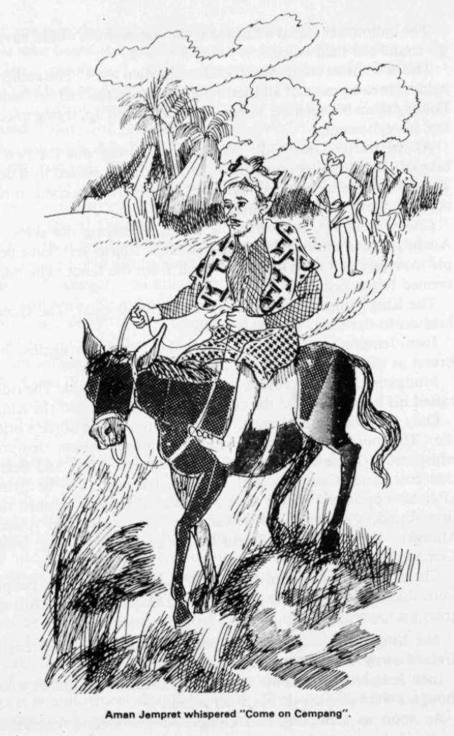
Only then did Aman Jempret hands tighten on his horse’s brid-dle. The horse now seemed ready to move. Aman Jempret whispered “Come on Cempang,” No sooner than it had heard that command, Cempang shot forward.

He seemed to be flying after his opponent. By the time Mungkur Uten had finished the first round, Cempang was beside him. On the second round, Mungkur Uten’s tired steps had hardly got him half-way, when Cemang finished. Cheers rose louder than before.

Who knows what the people were thinking! As they cheered happily they threw handfuls of grass up towards the sky. The King had collapsed in his seat. He was pale, his strength drained away. The Queen looked dejected.

Inen Jempret still held her hand to her breast. God knows what thoughts were passing through her mind! As soon as Cempang had completed the second victorious round, Aman Jempret walked it straight to his wife.

He pulled his wife on to the horse back. And from there, they saw Mungkur Uten finish his round, exhausted as a boat on a long journey. All eyes were turned on Cempang. Sitting upright on his horse, Aman Jempret faced the King and the people.

“I was willing to ride my horse against another horse, on your order, My Lord,” he said to the King. Then turning to the people, he added, “But I am not prepared to be your King, kind sirs, despite the King’s promise.”

He got off the horse, along with his wife. Then they walked slowly away. The people stared after them, so did the King.

Sumber Resmi:

INDONESIAN FOLK TALES
BALAI PUSTAKA STATE PUBLISHING AND PRINTING HOUSE BP No. 2993

All rights reserved First published in 1981
Perpustakaan Universitas Leiden (Leiden University Libraries) – Koleksi Digital (Digital Collections)

https://digitalcollections.universiteitleiden.nl/view/item/129019
 

Indonesia Folk Tale – GENALI Aceh – in English

 INDONESIAN FOLK TALES – ACEH

  • Genali Aman
  • Jempret
  • Malim Dewa

by M.J. Melalatoa
Translated by Krishna

GENALI

For a long time he had been absorbed in some work. For a long time his children had been buzzing around him like flies. Most of them got impatient but theire father paid hardly any attention to them.

Once he seemed to remember something. He got up and went indoors with the flock of eyes following his every movement keenly. A little later he emerged with some wire, cut it up into seven pieces. He sharpened the bits of wire and began shaping them into fishing-hooks. The children got more and more excited, they stood breath-less with anticipation.

genali

genali

They dreamt of the wide sea and the fishes they would pull out of it. Their father was so absorbed in his work that he ignored com-petely the reactions of his children. Suddenly he realized one piece of wire was missing. He looked around, he counted the pieces again. The children stood wondering what the matter was. “What’s up, Pa?” one of them asked. “There should be one more bit of wire.”

Some of them made a gesture of looking for it, others paid no attention what so ever. He looked sharply into the eyes of the children. His eyes were suspicious, and the children knew it.

Quickly and quietly he look-ed around the children, he was surprised. “Where’s Genau?” he asked after his favorite child, his youngest. The children started counting themselves too. “One, two, three, four, five, six, sev …”, they stopped.

One of the children tried again. “One, two, three, four, five, six, seven, there”, he said looking at his father. “One short” another pointed out. “Ya, where is Genali” their father repeated.

genali

Apparently Genali had vanished, without anyone noticing him, the suspicion in the father’s eyes gave way to worry. They all realized that Genali must have taken that bit of wire.

The father got back to his work. The children stood observing him and wondering about Genali.

“Where the hell is he, get him”, said their father half absorbed in his work. The one who had caught his father’s eyes went off reluctantly, others paid no heed to the command.

Genali had already reached the sea-beach, he was on the edge of the sea, far from their home. The string he had stolen from his mother’s sewing-box, he attached to the piece of wire that was yet to be sharpened and shaped. And he sailed towards the deep waters on a plank of wood.

Full of hope, he sunk his line into the water. The wooden plank that he rode, swayed under him, pushed by the waves that rolled out towards the shore. Genali sat still as though he was deep in meditation.

He was waiting for a fish—he was sure one would attach itself to his line. Just one, and he’d be happy, he’d run home fast as lightning.

He’d proudly present his fish to his mother, his father, his brothers and sisters. How they would all admire him, especially all his brothers: he sat there day-dreaming, thus. As he sat there full of hope, he suddenly felt a tiny pull on his line. He was so thrilled that his heart raced in his breast, just as the waves raced towards the shore. In his mind’s eye he saw a fish, with which he ran home, fast as the wind, his father’s face lighting up as he welcomed Genali, his brothers and sisters pouring around him in admiration, all looking up at him with great respect.

Such were the thoughts that filled his mind. The magic of the sea continued to pull him. The more he believed in his good fortune, the more joyous he became, and the stronger was the pull on his hand.

His father’s happy face was mir-rored more and more clearly on the surface of the sea. Once the pull was so strong that the boat almost upturned. The pull only made him more vigilant in the pursuit of the prey. He was sure that in a while it would succumb to him. But the line stretched out more tensely, the atmosphere grew tense with it.

The pull from below was growing powerful. Genali wound his line several times around the reel, still believing that he’d win. His boat moved like a ship just released from its anchor with Genali perched on it like a resolute captain.

The boat floated further and further away from the shore.

Genali, absorbed in his fishing, seemed not to know this. The fish for which he craved, was not yet out of the sea.

He kept releasing and reeling in the line in his hand, in an effort to tire out the fish. Once in a while, when his concentration lapsed, he’d look around, and his distress would grow.

From time to time he was overcome by an apprehension of death. But then in the mirror of the sea he would see the sad face of his mother, his brothers and sisters being ordered to look for him, and he’d shake off his pessimism.

If I don’t get back home by evening they’re sure to feel terribly sad, they’re sure to cry, he thought consufed and distress-ed as he floated further out in the sea.

He looked around gloomily. His troubled imagination loomed on him like a dark cloud.

Despite the confusion, he held on tightly and carefully wound the line around the reel, and drifted … who knew where. At least his boat wouldn’t sink until the wood rotted. He was safe, he thought.

For days and nights Genali floated in the sea, for days and nights remained in woe and fear. But still he persevered.

He had been starving for days, and there was only the sea water to quench his thirst. His boat pulled ahead towards some uncharted shore. In his heart was only one prayer: may this strange fish in its mercy carry him back to the shore where his mind and soul were anchored, the shore where his mother was weeping out her eyes.

But his earnest prayers met with no answer. One morning his eyes that thirsted for the sight of land, sud-denly saw a distant patch of solid grey. His heart jumped in joy. He watched eagerly. Then his hesitation returned, he rubbed his eyes. His grew apprehensive again—for days he had known only dread and doubt.

“I wonder if that animal will attack, it’s too big to be human,” he thought and swallowed hard.

“And, and, I’m small enough to be swallowed by it.” He rubbed his eyes again and again to make sure he was seeing right.

All of sudden his heart cried out in joy, “It seems, I have been facing a test these last few days,” he wept in happiness, then a confident smile settled on his face.

“Oh, I’ve returned safely. I’m saved,” he whispered tiredly to himself.

“Pa, Ma, here, your boy’s come back! I know you’ve suffered for days. Forgive me!” His face was bright in the light that reflected off the waves. The earth spread out before him promising fulfilment of his hope—he was going back to those who loved him, back into their embrace.

And then it began to rain. A joyous drizzle, that seemed to cheer his arrival. Genali felt it was a spray as cool and fresh as was fit for a returning hero. The grey land was surely not a mirage. It was real. But why — why was it so small?

Genali wondered, hardly big enough to be the central square of the city. There were no large trees, only grass sprouted all over it and a few bushes grew here and there. It was as though the island had sprung to life only recently. The boat and the sailor continued to be drawn towards the island by some unknown force.

Genali felt he was having a pleasant dream; for in all his life he hadn’t seen such and island, had’nt even heard of some thing like this in a fairy tale. He was sharply shaken out of his daydream as the boat struck the island. “Strange ship,” he whispered.

He looked up at the sky as if in prayer. Then slowly he hung his head. “Strange fish, strange fishing-rod! Who has wished all this upon me? Is it God or is it this little fish?”

He looked at the reel — it was still neatly rolled up. Slowly he stepped on to the land, stood straight and drew a long breath. He started pulling up the line; it began to come up smoothly.

“Strange! Now he gives himself up to me, after he has got me into this strange island”.

He kept reeling in the line. And at the end of it there appeard a wriggling little fish. It didn’t seem to have any fight left in it — perhaps strength had all been used up in the long journey they had come through together. Tired though he was, Genali kept rolling up the line. He admired the shining little thing at the end of the line. “Little gold fish,” he drew a deep breath; he was struck by wonder.

“Such a little fish,” he repeated, talking to himself. “How could it pull such a big boat for such a long time?”

“I don’t know,” he answered himself, shaking his head. He took the fish off the hook and tied it to a bush.

Genali watched the fish wriggling. He moved his fingers along the line that had been embedded in the little fish for so many days. Genali looked round desperately, his eyes took in the whole of the tiny island. Then he turned to the direction from which he had come. There was solitude all around. Idly he started to explore the island. To the north, to the south, to the eight directions from which the winds blew, there was nothing to attract his attention.

The emptiness was over-whelming; lonely and dreary. Tired of roaming around the tiny island, he lay down. He could lie wherever he wanted to. From the north, from the south, from the eight directions of the winds, there came none to disturb him. Tired of lying around, he’d get up again to walk around till the run rose high in the sky.

Late at night, or early ifi the dawn, there was nothing to break his solitude. The only thing that broke this boredom was brooding — brooding like a sick chicken! He finally even got enough of brooding. And all this time he had eaten nothing apart from eating out his heart. This went on for days, for months, and more. Walk around, lie around, brood and eat out his heart. Once in a while he would take a look at his little friend who lay tied down on the beach. This was the only place where he could talk to another creature. Otherwise he had to talk to himself.

Slowly his clothes began to wear out and finally they fell away together.

But Genali didn’t worry about it. There was one thing, though, that he never forgot. Pray-pray to the Lord, Genali knew all this was His will. He had been told one night by his father, just before he fell asleep:

“Everything depends upon God’s will. All our desires and wishes are subject to His. People who don’t pray will incur his anger.”

His father’s warnings were still fresh in Genali’s mind, so he always prayed. Hopefully …he thought. Hopefully … what?

He didn’t even know what to hope for! He grew used to solitude, it didn’t seem so oppresive any longer. Sometimes a plan took shape in his mind; he hardly understood the plan himself … where did the idea come from … and why? How was it to be executed?

He turned the plan over in his mind. Sometimes he talked about it to his little friend on the beach. Sometimes he congratulated himself for having such a brilliant plan. But one problem he could not solve—although he tried to time and again: how would he bring about that which was not there? For this he always turned to God and hoped He wouldshow him the way. He alleviated his boredom by traveling from one fancy to another, from one dream to another, from one puzzle to another.

The rhythm of the waves was the only music—at times it sounded sweet. But sometimes he hated it all so much, that he thought that the little island was hell. For indeed solitude is hell. One day, when he was deep in thought, he fancied he saw another distant island … or was it a mirage? His eyes focused sharply on the image — trying to make sure what it was. “I’m wrong,” he sighed, between trembling lips. His eyes re-mained alert. “No,” he argued with himself, the image is growing clearer. His heart clamoured loudly in hope and fear. “It’s moving towards me, towards this tiny island,” his heart lit up with hope.

“It must be coming to fetch me, it must have come looking for me at my loving father’s command. Or … or, perhaps Pa, Ma, and just everyone is on that §hip!”

He seemed more and more sure that help was near.

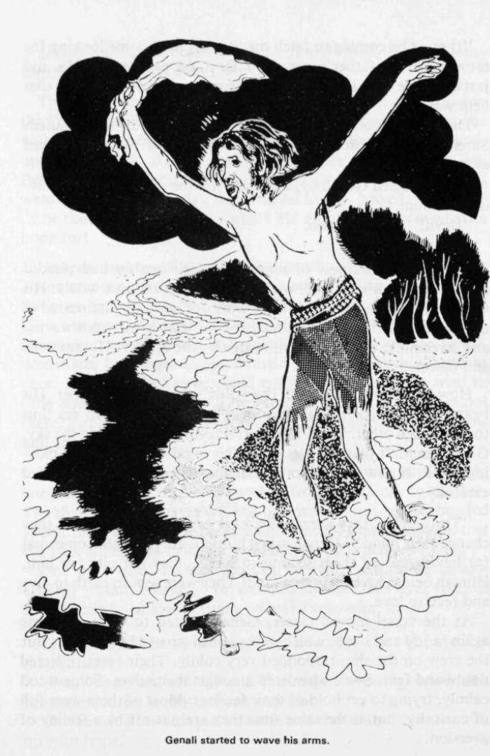
The vessel got closer. Genali waved his arms wildly and shouted. Surely the people on the ship could see him now! The ship creeped along. Then it passed Genali by, betraying not the slightest hint of having seen him! “Devil!” hissed Genali. “Devil!”

Oh, the heartlessness of mankind! Their apathy had pierced deep into Genali’s soul. He waved his hands even more wildly. His voice was hoarse, hurling at once words of entreaty and hatred at the inmates of the ship. Gradually he got exhausted from waving and screaming; he was beaten, beaten by the apathy. He was tired and dejected.

How brutal was mankind! They didn’t care for each other.

His heart cried out, damning those people. Why must men act thus towards each other. Why! His heart screamed out piercing the sky.

Genali couldn’t take his eyes — nor his mind — off the slow mov-ing vessel. It now seemed to be changing its course.

Genali looked carefully. “Truly, truly, they are coming back towards me. Why did they change their mind?” Genali asked himself.

He regretted somewhat for having cursed them so much. Surely, they felt pity for him. Human beings love their own kind! They were sent to earth to give and receive love.

As the vessel moved closer, Genali started to wave his arms again in joy and hope, which now seemed sure to be fulfilled. But the crew on the ship responded very coldly. Their faces reflected doubt and fear. Some whispered amongst themselves. Some stood calmly, trying to get hold of their feelings. Most of them were full of curiosity, but at the same time they are put off by a feeling of aversion.

What sort of a creature was it that lived on this island all alone! Surely that wasn’t a human being! Perhaps it destroyed all the passing vessels. Thus thought the sailors.

Doubts and fears made them forget the sailors code of behaviour. They were facing a pro-blem that had no precedents in their past experience in navigation.

“Ever seen anything like this, you’ve been sailing the seas for ages,” someone asked an elderly man. The latter shook his head in reply.

“Strange, that a ship should change its course, all by itself,” said the old man to himself. Meanwhile the captain tried to get the ship away from the island of the naked man.

But no amount of force could move the ship off its course. The crew, their minds full of question, gaped at the queer scene as they tried to get away from it. Their attitude upset Genali.

“It seems they have only come back to bother me,” he thought.

“But it doesn’t matter. I have to ask for help.” He tried to be patient. By and by he grew suspicious again.

“Perhaps this isn’t a vessel of ordinary human beings at all. They are creatures who have come to frighten me. May be, it’s they who own this curious little island. And they are probably angry with me,” he cautioned himself.

“Or perhaps they own the whole ocean and they are now going around their island one by one. They are trying to guard it against anyone else taking over their territory. And if there is any strong and foreign army, they are to destroy it.”

“But then I don’t look like a conqueror,” Genali explained, to no one in particular.

“I am only a poor soul who has been brought by fate to this damned island. I have my own country, where I want to live. But I don’t even know in which direction it lies. If I was to be taken back to my family, only to turn to dust once I was there, I would still rather that, than live in such solitude. Hey, Sea, hey, Waves, or whoever else can hear me, Im not a conquerer, not even descendant from one.”

The ship had moved away again, it was almost lost in the grey mist. Genali smiled bitterly.

“Oh, no, I’m no conquerer. I am only an unfortunate man in the midst of solitude.” His eyes, still observing the ship on the horizon, saw it change its course again.

“Gee, they seem to be coming back. They have decided that I am trying to take over their island. Else, why should they come back? They’ll get me and pull me to bits. They don’t want anyone to take this island. They won’t hear my explanation — that I have been brought here only by accident. No doubt they are coming towards me. Moving in on their prey, at the order from their master. I’ve come to the end of my days. Dying unknown to all, apart from myself and those sailors”.

Genali shuddered. His frightened fantasy knew no bounds. He remembered the loving embrace of his mother. He thought what happy lives his brothers and sisters were living, enjoying their parents affection. While he, poor Genali, in a little while, would be facing the supreme Lord!

The sea breeze blew gently over his body. Why did he ever call out to that ship, he thought angrily. Now the ship was getting closer again. The crew stared open-mouthed at Genali. Fright and uncertain-ty seemed to have taken over the ship.

“So surprising that the ship should move on its own will. Perhaps it can even sink us at its will. It’s just playing around with us,” said one of the frightened members of the crew. The others only half listened to him. An elderly member of the crew sug-gested: “Let us pray to God for His guidance. With His help, we shall be able to overcome this danger. But if this be His will, we can do nothing about it.”

The advice passed from mouth to mouth. Some raised their hands in prayer.

The ship was now only a little distance away from the beach where Genali stood. Genali collected his thoughts and came to a conclusion.: “If indeed I am their prey, they can do what they want unto me. If 1 am regarded as trespasser — well, indeed this land is not mine, nor that of my ancestors. This is probably their ancestral land. It is their duty to save this land from falling into other hands. I have no right to be here — nor do I wish to be here!”

Then Genali tried to reasure himself.

“Is it possible that none of them will have any pity for me? Won’t any of them have a heart as tender as I knew among the people of my village?” Genali let his mind wander far away, as he waited for the vessel to land. The vessel too seemed to be slow and unwilling.

“If they want me to go away and live with them, I am happy to do so. That will at least ensure that I go on living for a while longer!” The ship had landed. The passengers and crew gazed fixedly at this naked man.

Genali thought their eyes were accusing him. He waited for them to scream out their charges against him. He waited for the explosion with a trembling heart. But nothing was said. Each side regarded the other with suspicion. Impatient with waiting, Genali drew upon the last reserve of his courage and spoke softly: “I called out to you, gentlemen.”

Genali looked from one face to another, trying to anticipate which of those men would be the first to give vent to his fury. All the brows were fur-rowed. Genali could wait any longer.

He wished something would change the unbearable situation.

“I called out to you, gentlemen, again and again. I waved my hands so that you could see me.” He waited for an answer. But the sailors just looked on spell-bound.

Genali was really annoyed, and spoke rudely: “You people seemed so arrogant. I thought you were having fun at my expense.” Hearing that the sailors looked at each other and whispered as if holding a consultation, Genali thought for a moment.

“Actually, gentlemen, if you will be so good, I wish to seek a favour from you,” he said hesitantly.

“Could you possibly fulfill my requests?” he added with a little more courage.

“What do you want, Sir?” asked one of the sailors. Both sides were now very polite and respectful in their speech. Genali hesitated again. What should he ask for. Should he ask to be taken from the island? Who knows where they’d take him.

He could be killed in the end. He’d rather strugle alone and die alone. Because he felt safer now, he thought he would start by making a gesture of good-will.

“I wish to send a gift to your king. Would you take it to him?” The inmates of the ship looked at each other, not knowing how to respond. One of them spoke up: “With pleasure. What would you like to send, Sir?”

Genali went to where the fish lay.

“Some of these men are okay,” he thought. He felt he would be saved soon. If not tomorrow … then the day after.

“What’s important is that I try to attract the king’s attention.”

“Hope you gentlemen will carry this little fish to your king. I hope this gift will please him.” The sailors received the fish graciously. The two sides politely thanked each other for their kindness. Yet though they were evidently unharmed so far, they remained suspicious about how this situation would develop.

“Do you have any other message for our king, Sir? We are hap-py to convey it to him, for you.” Genali was pleasantly surprised by their generous offer. He answered without even bothering to think carefully.

“Should your king be so kind, I should like a white cock with sharp claws and about four arm-lengths of white cloth.” Taking this message, the sailors set off again, with many ques-tions in their minds, still unanswered. The vessel creeped into the mist.

Gradually, it vanished from sight. Soon after reaching their own country, a group of these sailors met their king. With a great deal of eagerness they proceeded to report to the king their strange experience.

The king listened atten-tively and graciously received the gift of the fish from foreign seas. It pleased the king.

“I feel honoured receiving this gift. I’m sure this fish is extremely tasty.” The king smiled widely. He ordered that it be cooked at once with delicate spices and be served to him and his chief queen for dinner.

But the king was to be surprised again for when the fish was cut up, they found large, bright and valueable diamonds in its stomach! Having seen this wonderful gift with his own eyes, the king remembered the other message that the sailors had brought from the man on the island.

The king began to wonder what to do about it. He couldn’t decide by himself. So he called for an immediate meeting of all his counsellors. The council included the ministers, the religious leaders, the fortune-tellers and members of the royal family.

He also asked the sailors who had met the strange man, to join the meating.

“Today, I have called all the counsellors, as well as some of our sailors, There is a matter which I regard as being of national im-portance. It is not just a matter for the residents of the palace alone, or for ministers only, but perhaps it concerns the whole of the populace. I feel this is not a problem that can be solved by just a few of us, and certaintly not by me alone.”

The king reported to the council the story of the sailors and showed them all the jewels that had come from the fish’s stomach. Everyone was struck dumb with wonder.

“Apart from this,” the king continued, “This man asked for a white cock with sharp claws and four arm-lengths of white cloth,” the king finished and looked around the assembled counsellors.

“Now you have heard it all. What do you think this means?” No one spoke. They were all thinking hard. The king’s magician broke the silence. He said: “I think this is no great problem. The man probably means no harm. He only wants to be good to us and in return expects generosity from us, from our king. That’s all.”

The magician seemed proud that he had been able to present his ideas. The councellors whispered and nodded. The king looked satisfied, too. But one old sailor warned: “Be careful, whatever you do.” The magician looked bashful, embarrassed since his vanity had been wounded by the old sailor’s objection.

The rest of the assembly re-mained silent. Everyone seemed to have been struck dumb again, the ministers, religious leaders, and all.

“Yes, let’s try to think carefully about this,” the king looked hopefully around his audience. He waited for some suggestion from some one — any one. Once more there was a long silence.

“If no one can deal with this, let me take a decission. I shall go by the suggestion of my magician.” The magician glowed with pride.

“I order the sailors to carry the things the man wanted to his island.” The king picked up the hammer to bang the session to a close. But Princess Terus Mata grabbed her father’s hand.

“Don’t, Father, don’t.”

“You are being reckless, Father, and all your counsellors are fools,” she looked around angrily. Every body was stunned by the princes’ sudden gesture. The king too was confused. The magician turned red in shame.

“Are your counsellors always this stupid in facing problems of government?” She looked at her father.

“You must revise your thoughtless decission.”

“What is it my child?”

“You are being reckless, Father.”

“Perhaps, Dear!”

“Perhaps Dear?!” She repeated her fathers words, forgetting herself in her anger. Her eyes glistened, tears began to roll out. A dead silence descended upon the assembly, as if they were sitting around someone’s death-bed.

“Why are you so angry, my child, that you go against your own father?” her mother asked gently.

“These ministers, and everybody here, and especially that magi-cian,” the princess pointed at her target.

“They must be dismissed at once” … The atmosphere was tense and the magician trembled with fear. The princess fell silent and hung her head, burdened down by distress.

“Forgive me, Sire,” she said heavily as she slowly raised her eyes to her father’s face.

“You must forgive me too, my child,” the king said, choked with emotion.

“What, my dear, do you know about all this? Please tell us,” requested the king.

“Your decision was one that would bring calamity to all your subjects. Is it the job of this counsil to bring on calamity?”

“That was not our intention, at all, my child.”

“But that’s what your decision just did.”

“We didn’t know.”

“But shouldn’t some one know?”

“Well, if we don’t know> and then as a result of our ignorance, calamity descends upon us, it is God’s will that it should be so.” Her father’s argument only angered the princess*.

“God helps those who help themselves. The curse will come upon us only if we make no effort to fight it. Your counsellors and your magician don’t seem to know their jobs.”

“Once again, I beg your pardon, my child. If there’s something you know, tell it to this assembly.” She bowed her woebegone face. The audience felt her sorrow. She didn’t seem angry any more when she raised her head to look at her parents.

“He didn’t ask for a white cock, Sire.”

“This state will fulfill his demand, whatever it may be. I pro-mise, Darling. Just say what it is. Just say it,” he repeated.

“You really don’t know what he wants?” she asked hoarsely. The king and his court stood bewildered.

“He wants me. The white cock is really me, your daughter, Sire.”

“You’re mad,” started her mother, as if struck by lightning.

“That’s impossible.”

“It’s not impossible; indeed it is the truth and there is no point trying to argue with reality.”

“You are dreaming, Terus Mata,” her mother said sharply.

“No, I am not dreaming now; but I did have a dream some nights ago, and knew that this was going to happen.”

“Oh, surely you are day-dreaming, my child,” said the Queen, annoyed.

“You didn’t think you were all dreaming when you got that strange fish.”

“But are you ready to go, Terus Mata?”

“My father is already sworn to fulfilling the demands ….”

“I am not,” said the king taken aback.” When did I swear?”

“You are ill, Terus Mata.”

“Not at all. I am in perfect health, Mother. But this court is stupid and they are going to bring distress to our people.”

“How you denounce us all, Terus Mata!” the king said ex-asperated.

“Your accusation has no basis.”

“The basis, Sire, is that you received the fish and ate it without any consideration of what these strange incidents were all about. You just felt honoured by the gift. God!”

She exclaimed. The king felt as though he had been stabbed in the heart, he looked at the floor, while his daughter continued calmly.

“Now you have to face the concequences of all that has happen-ed. And nothing is impossible. Perhaps all this was destined to happen to me, to you two, Mama and Papa, to all of us, to this land.” Her mother could no longer hold back her tears.

The Princess walked up to her mother, they embraced each other. The whole court was touched by their love and their sorrow.

“Is there no way out, my darling?” asked the Queen, releasing her daughter from her arms.

“There is, Mother.”

“What is it, my child,” she stepped forward to embrace her child again. But Terus Mata stepped back.

“The alternative is for every one in this kingdom to face disaster.” Her mother’s heart shrunk in fear, at these words.

“And now with all due respect, I bid you, my Father and my King …”. The king looked listlessly at the hammer; he picked it up …he seemed nailed to the floor.

The Princess’ voice trembled as she issued the orders.

“Pick it up!” The king picked the hammer up unwillingly, “And bang itu!” The hammer came down slowly, of its own ac-cord. Silence reigned supreme, only the Queen’s sob broke through it from time to time.

Terus Mata hung her head; her misery flowed out of her eyes in drops of tears. The meeting dispersed in confusion. Within a few days the provisions needed to set sail were made ready. These included horses, oxen, chickens, ducks and a lot of other things.

On an auspicious day, Princess Terus Mata, set out with her escorts, towards her new land. Tears of her subjects and her parents flooded the harbour. As the ship vanished beyond the mist, they could hear the princess singing from the deck of the slowly moving ship.

She sang.

“Fare-well, the sky above our heads. Peace be to my motherland. May you embrace and protect all that is yours, while I go wandering towards my future.” The ship sailed through the mist for a whole month. The travellers on it were determined to face up to their unknown future in the new land.

A dark mound now appeared on the horizon. The sight of it increased Terus Mata’s heart beat. What did the future hold?! The ship docked at the edge of the island.

The sailors who had stopped here before had called it ‘Linge’. For that was the sound they seemed to have heard when Genali had called out to them. From their ship, they could see a human figure. It was a com-pletely naked man. The women hid the faces behind their veils.

One man carried to Genali the piece of cloth he had ordered, to cover himself. Shy and blushing, Terus Mata walked ashore, while her atten-dants got things organized in the ship.

The first meeting of a hesitant handshake beneath faces bowed shyly, started a new epoch of history. Gradually the two drew close to each other, as was evident to all from their friendly behaviour and the sweet expression on their faces. One bright afternoon Genali took Terus Mata out to the beach where he had once kept the fish.

Terus Mata asked him politely.

“How did you come to be here?”

“It was all beyond my control, perhaps it happened by the will of the All Powerful One.” Between words he looked in admiration at the serene face of the princess.

“And may I know your real name?” Genali told her his name. He added: “But I don’t know what’s real and what isn’t, any longer. That was the name by which I remember being addressed by my parents.”

Genali hung his head. His mind travelled back to his family, especially to his parents.

“Forgive me if I seem sentimental. I am thinking of my parents. Perhaps they are still looking for me. Probably they are very old now. They’ve grown old through worrying about me, and in their hearts, they still weep for me.”

Terus Mata wiped her eyes. She could control herself no longer and wept as if her heart would break.

“I had to tell you, because you asked,” Genali said.

“But if God is willing, we will see our parents again.” Terus Mata tried to reassure herself and Genali.

“Yes, perhaps. Who can tell! But if my mother has died broken hearted because of me, the knowledge would be too great a burden to bear. If she has died of old age, then I would still wish to visit her grave. But where can I go in search of her? I can’t even recall the direction from which I came. Besides since your ship has been here, I have felt as if all that is mine is here with me.”

Terus Mata’s eyes glistened as she heard Genali. It pleased her to hear Genali speak thus.

“Thank heaven, that you have been able to overcome your misfortune. And I have come here to help you.” From then on Terus Mata and Genali were open and honest with each other.

Finally, on an auspicious day they were married by the priest who had accompanied Terus Mata. The marriage was celebrated for seven days and seven nights according to the con-vention of the Princess’ country. At the end of the celebrations, they held a consultation and decided to make Genali the head of the state of Linge.

He was given the title of ‘Kejurun’. The kejurun of Linge, was aided by two wise men with titles of ‘Peutu’ and ‘Imem’. In all decisions, the head of the state was to be guided by these two officers. Almost unnoticed by the people and their leader, the state of Linge grew bigger.

For the water receded, and more and more land arose from below the sea. The island was planted with trees brought from Terus Mata’s country and the animals had begun to procreate. The light of prosperity was unfolding before the people of Linge under the wise leadership of their head and his advisers.

In the midst of peace and prosperity, the head of the state of Linge was blessed with a son who was named Johanshah. After the son Johanshah, a daughter was born and she was named Merah Abuk. And so Genali and Terus Mata were truly blessed, for they had a son and a daughter whom they loved.

And even more blessed was Genali, as the trusted leader of a people, who were graced with peace and prosperity.

Sumber Resmi:

INDONESIAN FOLK TALES
BALAI PUSTAKA STATE PUBLISHING AND PRINTING HOUSE BP No. 2993

All rights reserved First published in 1981
Perpustakaan Universitas Leiden (Leiden University Libraries) – Koleksi Digital (Digital Collections)

https://digitalcollections.universiteitleiden.nl/view/item/129019

« Older posts

© 2026 Anglurabisatya

Theme by Anders Noren — Up ↑