by Purbatjaraka
Translated by David T. Hill
calon arang image
Calon Arang [1]
“May nothing stand in your way!” Thus say the old people who tell the story of Mpu Bharadah, who used to live in an ascetic’s hermitage at Lemah-tulis. His mystical power and especially his knowledge of the dhartna had no equal. He had attained the peak of knowledge and knew all about the destiny of the world. His powers of asceticism were amazing!
He had one very beautiful daughter, called Wedawati, who lov-ed to dress up. Then Mpu Bharadah’s wife, Wedawati’s mother, fell ill and died. Wedawati was broken hearted.
She threw herself upon the ground and wailed beside the body of her mother, mourning and lamenting: “Oh, mother, who will take pity on my miserable soul?” Her mother’s corpse was taken to the cemetery to be cremated, after which, having been rendered perfect, her mother ascended into heaven. We will say no more about her. Mpu Bharadah then re-married and had a son. In short, the child grew up quickly until the time soon came when he could dress himself.
One day Mpu Bharadah went to his hermitage at Wiçyamukka where he meditated. He made sacrifices there and many students came to see him. Let us leave him for the moment, and continue the story of Wedawati. She was scolded by her step-mother and became very cranky. She wept and would not dress herself proper-ly. Instead she went to the cemetery where her mother had been cremated. Under a large banyan tree she came across the corpses of four people who had been killed because they were accused of weaving black magic.
There was a baby suckling at the breast of its dead mother, who had itching ants swarming over her. Wedawati was very moved at the sight. Slowly she left there and headed for her mother’s cremation site.
She sat down under a kepuh tree, lamenting to her mother: “Mother, take me immediately!” Thus Wedawati mourned. We will speak no more of her for the present. Let us return to Mpu Bharadah. He came home from the place where he had conducted the sacrifices and sat down in the pendopo ( a wall-less shelter where guests may congregate.). His wife came and told him that his child, Wedawati, had been misbehaving.
She had been looking for flowers with her younger brother, but had fought with him over them. They had both ended up crying and she had run away. Her brothers and sisters had gone in search of her, but she was nowhere to be found.
The sage said: “I will go and look for her now.” And he went and searched for his child. In an open field he came across a young shepherd.
Asking gently, he said, “Greetings, shepherd boy. Do you know my child, Wedawati? Have you met her? Do you know where she has gone?”
The shepherd boy replied, “I have seen a beautiful veilled maiden, weeping and calling for her mother, walking towards the southwest.” The sage followed his child hastily, coming straightaway to his wife’s cremation site. There he found signs that his child had been rolling on the ground, and weeping beside the place where his wife was cremated.
He looked to the north, south, east and west, and noticed his child sitting on a rock, hidden behind the roots of the kepuh tree.
Said the sage, “Oh my child, how mischievous you have been, coming to your mother’s graveside. That is enough, child. Do not carry on like this. Life is like that. We all have to die eventually. Come, my child, let us go home. Do not give in, my dear.”
His child replied, “I want to go with Mother. I am so terribly sad. I cannot be separated from her. I want to go to Mother.”
Said the sage, “My child, my dear! You must do as I-say!” And so the child went home, obeying her father’s instruction. By the time they arrived at Lemah-tulis it was night-time. Through the night Wedawati was given guidance by her father about the way of piety. Wedawati followed her father’s every word. Some time later the sage went again to Wipyamukha to make more sacrifices. Arriving there he was greeted by all his pupils, and given tribute. The holy sage then taught the true road to his pupils.
We will tell no more of the sage for the moment. Let us return to Wedawati. She was scolded by her stepmother once more. The daughter cried, not knowing what she should do, but getting very angry. Again, she went to her mother’s cremation site. Without going into details about her journey, she arrived quickly at the place where her mother had been cremated, and wept, rolling on the ground and lamenting.
“Oh my mother”, she cried, “see what misery I am suffering. I ask to be taken im-mediately. Do not leave me here. Let me follow you, Mother.” Let us say no more about her, and return to the sage.
He came from making his sacrifices and sat in the pendopo, calling to his daughter, “Where are you, my child? Come here my dear Weda-wati, and bring your brother.” But no-one answered.
Then the stepmother approached him and said, “My Lord, your daughter has been naughty again, arguing with her younger brother. I could not separate them. Then suddenly she left. Her brothers and sisters have searched for her, but she is nowhere to be found.”
The sage replied, “Ah, she must have gone to her mother’s cremation site!” He got down from his seat and went off to find his daughter in the cemetery. The sage walked quickly and found his child by the grave.
Then said the sage, “Oh, Wedawati, my child, my dear. Let us go home. Let me take you home, my child.” But Wedawati did not reply. The sage was confused to see his daughter behave so. He sat beneath the kepuh tree instructing his daughter in correct behaviour.
For a long time he talked with her, and finally Wedawati said, “Father, I do not want to return to the Lemah-tulis hermitage. Let me die in this graveyard and follow my mother. Let me stay here until I die under this kepuh tree. However I am to meet my death, let me pass away on this very spot.” Mpu Bharadah instructed his pupils to move his residence to the place where he was sheltering beside the grave.
The sage intended to make the cremation site into his hermitage. So his pupils levell-ed the land, blessed it and built apendopo for guests and a place to live, but most importantly a temple for offerings and a gateway. A fence was made with sirih* trees planted in rows. They planted all kinds of plants and flowers.
When the hermitage was finished it was absolutely beautiful! Wedawati was happy that the retreat had been built at her mother’s cremation site. The sage made his per-manent home there at the hermitage. Let us now leave the story of the sage.
Calon Arang [2]
Let us tell the story of the King of Daha. His Majesty was a great king who was happy in his rule because the people were prosperous under his governance. His Majesty’s name was Erlangga, a good and kind monarch. The story is told of a widow called Calon Arang, who lived in the village of Girah.
She had a very beautiful daughter called Rat-na Manggali. But despite her beauty no-one came with offers of marriage. No-one from Girah village even came to seek her hand in marriage, not to mention from the town of Daha, and certainly no-one from any further afield, on the periphery of the kingdom.
They were afraid to make overtures for the hand of Ratna Mang-gali, the daughter of the widow of Girah, because it was known far and wide that the widow of Girah had an evil nature. There was no-one for miles and miles who would propose to Manggali.
One day the widow of Girah said to herself, “Why on earth does no-one seek to marry my daughter? Despite her beauty, not a soul comes to propose. It makes me so angry! Well, I shall study my texts. If I read my book, I shall come before the Goddess Bhagawati. I will ask that she grant me a boon, and destroy the in-habitants of the entire kingdom. After reading her book she went to the cemetery accompanied by all her pupils, to beg a favour from the Goddess Bhagawati. And the names of her pupils were: Wökcirsa, Mahisawadana, Lëndë, Guyang, Larung, and Gandi.
It was they who escorted the widow of Girah; it was they who danced and twirled in the graveyard. The Goddess Durga, who is also called Bhagawati, showed up with all her retinue to join in the dancing and whirling. Calon Arang paid homage to the goddes Bhagawati to which the Goddess replied, “Calon Arang, my child, why have you come to me and made obeisance, escorted by all your pupils?”
The widow came, with her hands together at her forehead, “My Lady, your servant requests that all the people throughout the en-tire kingdome be destroyed. This is your servant’s reason for com-ing.” The Goddess replied, “I agree, my child, but never let your anger rule your judgement.” The widow thanked her, and took leave of the Goddess Bhaga-wati with a sign of homage. Calon Arang, along with all her pupils danced through the middle of the night at the crossroads.
They played their instruments and danced. Then, having finished their dance, they went home, altogether, to Girah. Not long after, people in the villages began to fall ill, and many died. One after the other, without ceasing, the death rate rose. Let us say no more of Calon Arang for the moment.
Calon Arang [3]
Let us listen to the story of His Majesty, the King of Daha. His Majesty, King Erlangga, was seated in his audience room. His patih (the vizier or senior official in the court.) came to him, respectfully, saying that many of the people and the soldiers were dying of a raging fever. Within a day or two the sickness caused death. Someone had seen the widow of Girah, Calon Arang, making supplications to the Goddess Bhagawati.
She was seen dancing and twirling together with all her pupils at the crossroads. Many people had seen them. Thus said the patih, and all the people who had gathered around acknowledged the truth of his words.
The king spoke, saying, “Oh, my people and my soldiers, kill this Calon Arang, stealthily, but it cannot be done by just one per-son. Take the army.”
The soldiers took leave of His Royal Highness making obeisance, saying “We beg your permission to kill this widow of Girah.” The soldiers and the people departed. We will not describe their journey, but they arrived quickly at Girah, going straightaway to Calon Arang’s house, while the people there were asleep. There was no sound of anyone standing watch there. Swift-ly one of the soldiers grabbed the widow by the hair, drew his sword and was about to cut off her head, when his hand was struck paralysed.
Calon Arang awoke with a start, fire blazing from her eyes, nose, mouth and ears, the flaming tongues searing the soldiers. Two of them were incinerated. The other soldiers, some distance back, fled in terror. While nothing is described of their journey, those who had escaped death returned speedily to the palace and to the rest of the army.
There they approached the king humbly. “My Lord, we have failed. Two of your servants have been killed by the gaze of the widow of Girah. Tongues of fire lept from her body incinerating your servants.”
His Majesty replied, “If what you say is true, I have no idea what I should do next. The king then left the audience hall, and returned to the palace. Let us leave His Majesty and return to the tale of the widow of Girah. Having been attacked by the royal ar-my, she grew more and more infuriated. Calon Arang called her pupils and told them to come with her to the cemetery, after she had consulted her book once more. Having read from her book and escorted by all her pupils, she went to the graveside under a kepuh tree which was entwined by melata plants with their densely packed leaves casting out runners to the flat ground beneath.
There sat the widow of Girah, facing all her pupils. L£ndë said, “My Lady, why is it that you are so angry with the king? Would it not be better to do good, and ask a great sage to show you the road to paradise?” Then Larung said, “What do we care about His Majesty’s anger! On the contrary, we should intensify our efforts, even if it means striking right at the centre.” They all supported what Larung had said. Even Calon Arang agreed.
Then she said, “Yes, I agree whole-heartedly, Larung! Play you instruments! Dance one by one. Later when the time comes, you shall all dance together.” Immediately Guyang began to dance. She danced with her hands open, clapping, sitting on the ground and spinning around holding on to her wrap around skirt. She flashed her eyes, turning right and left. Larung pranced about; her movements like a tiger about to spring, eyes bloodshot, and her body naked.
He hair was. strag-gling over her face. Gandi danced, leaping, with her dishevelled hair falling to one side. Her eyes as red as the ganitri flower. Lende danced. She danced on tiptoe holding her skirt. Her eyes flashed like fire about to burst into flame. Her hair was unkempt. Then Wokçirsa pranced, bending over, twisting and turning from left to right; her eyes agog, without a blink. Her hair, a tangled mess, hung down one side as she danced stark naked. Ma-hisawadana danced, standing on just one leg.
Then she tumbled over, her tongue stuck out and her hands clawing and scratching at the air. How happy Calon Arang was, watching them cavort. She allocated tasks to her pupils so that she would be able to make her black magic strike right to the capital. She divided up the territory into the compass points, giving Lende charge over the south, Larung over the north, Guyang the east and Gandi the west. Calon Arang took charge of the centre of the kingdom with Wokçirsa and Mahisawadana.
Having divided up the realm into the four compass points, Calon Arang went to the middle of the graveyard, to get the corpse of someone who had died suddenly on a special Kliwon Saturday. She held the corpse up, tying it to a kepuh tree and gave life to it by breathing into the body. Wökcirsa and Mahisawadana stared wide-eyed. The dead man came to life again and said, “Who are you, my Lady, who can give life to me?
So boundless is your hum-ble servant’s debt to you that I may never be able to repay you. I will devote my life to you, my Lady. Release your servant from this kepuh tree so that I may bow my head to the ground before you in humble obeisance.” Wökcirsa said, “Do you think you will live that long? Why, I am going to slit your throat right now!” At that very moment, she cut his throat; the neck of the corpse which they had just brought back to life, was severed. Blood sprayed out and Calon Arang us-ed it to shampoo her hair which became clotted with the blood. The intestines she used for ornaments and bracelets. The body was cooked and presented as an offering to all the ghosts and evil spirits in the graveyard, and especially to the Goddess Bhagawati, who was given a tribute of offerings.
The Goddess Bhagawati descended from her heaven and said to Calon Arang, “Greetings, my child, Calon Arang. Why do you make these offerings to me, with homage and bowing? I thank you for your tributes!” The widow of Girah answered, “Oh, my Lady, My Goddess, His Majesty the king is angry with your humble servant, and so I come to ask your help in wiping out all the kingdom, even unto the very centre!”
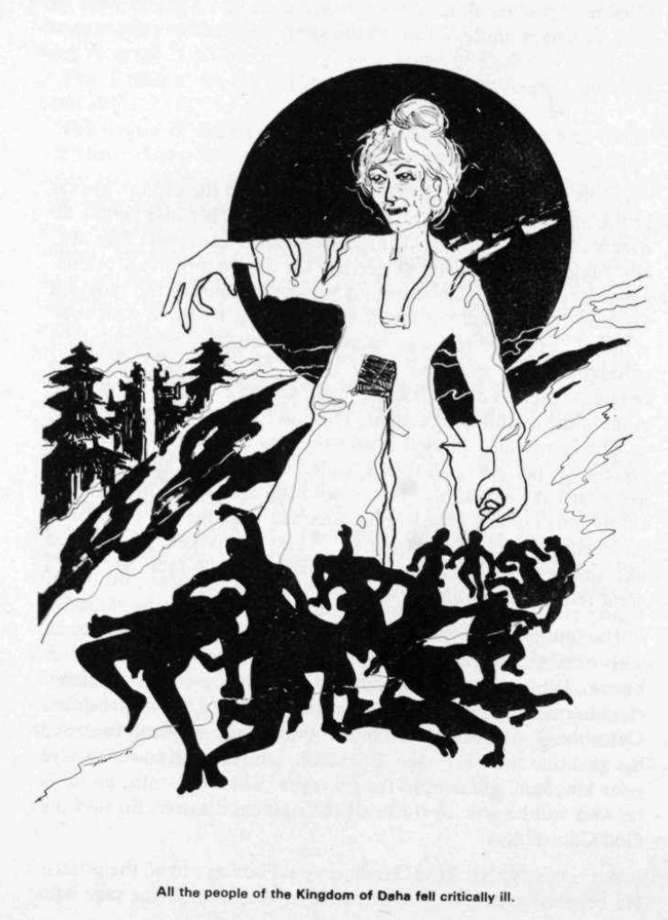
The Goddess spoke, “This I permit, Calon Arang, but be careful!” The widow of Girah made obeisance to the Goddess and took her leave. She went quickly from there, cavorting through the crossroads. All the people of the kingdom of Daha fell critically ill, sick with fever for a day or two, then dying. Corpses piled up in the graveyards, in the fields and in the streets; others rotted in the houses. Barking stray dogs ate the corpses. Flocks of ravens devoured the corpses, pecking at them. Flies droned in the houses; the villages became deserted. Those who survived fled to places far away, seeking refuge in those villages which had not yet been struck down by the disease. Those who were sick were carried on the backs of the healthy.
There were those who carried some of their children, guiding others while toting their bundles of belong-ings. The devilish spirits who saw them called out, “Do not flee. Your villages have returned to normal. There is no more threat from the disease. Go back. Do not stay here.” After this even more people who were fleeing with their belongings died along the roadside. The evil spirits and devils who were in the deserted villages lept with delight, joking with each other along the lanes and highways. Mahisawadana entered houses through the walls and everyone in the houses fell ill. Wokjirsa got into the people’s beds through the roof, opening it to the sky, and demanding sacrifices of fresh blood and raw meat.
“That is what I want, and do not take too long about it!”, she said. Let us speak no more of the people who were struck dead, or fell sick, or of the antics of these demons.
Calon Arang [4]
in the audience hall, sad and at his wit’s end, because people all over his kingdom were dying in droves with even more falling sick. His Majesty issued a royal decree that all the brahman priests, ascetics, priests of Shaivism and Buddhism and all the religious teachers throughout the kingdom be invited to come with their skills of prophesy to make sacrifices because so many subjects throughout the kingdom were dying of this pestilence. The religious teachers and priests all made sacrifices calling on the god Agni in the middle of the night.
The god Caturbhuya (known also as Shiva) revealed himself above the fire and said, “There is a great sage, perfect in all things, called Bharadah, who lives in the graveyard at Lemah-tulis. It is he who can save your kingdom and rid the earth of this catastrophe. Bharadah has the power to make your world prosperous once more.”
Having spoken, he vanished like smoke. The priests who had performed the sacrifices felt a great relief on hearing the words of the God Shiva. The following morning they left their place of sacrifice and came with obeisance to tell the king of the words of the God Catur-bhuya.
While his Royal Highness was sitting in the audience chamber the high priests spoke, saying, “Your Majesty, the God Caturbhuya has revealed himself above the sacrifical fire, and has said that there is a sage, Bharadah, who has the power to save your kingdom. He lives in the graveyard at Lemah-Tulis, and it is he who will be able to rid us of their global disaster. So said the God Caturbhuya.” Accordingly, His Royal Highness paid homage to all the priests.
He believed them, and so sent envoys to call upon the sage who resided in the graveyard.
“Kanuruhan , go to the graveyard of Lemah-tulis and invite this great sage Bharadah to come, for I will beg him to save the country from this pestilence. And do not dawdle!” The Kanuruhan ( a high court official. ) bowed to the ground then took leave of His Majesty. With the kanuruhan riding in his carriage and his retinue mounted on horseback, the journey was swift. Despite the onset of night, he continued to travel by the light of the moon. Only well into the night did he sleep by the road.
The following dawn the kanuruhan continued his journey, and soon came to the sage’s hermitage. The kanuruhan alighted from his carriage, entered the gate of the compound and met the asce’ic who happened to be at the hermitage at that time.
The sage greeted the guest warmly with the words, “Welcome, my son, though I know you not. What is your reason for coming here to this holy retreat?”
The kanuruhan answered him, saying, “Your servant comes from the town of Kediri; I have the position of kanuruhan. I come to you at the command of His Royal Highness, to invite you to return with me, my Lord. It is the intention of His Majesty, if my Lord comes to the city, to beg a boon from my Lord, to save the kingdom now struck by a pestilence which brings death to many of the people. There is a widow of Girah, called Calon Arang, who has a daughter called Manggali, but no-one will have anything to do with them. For this reason Calon Arang became furious, for no-one would ask for the hand of her daughter in marriage.”
The sage answered, “I have no objections. Permit one of my pupils called Mpu Bahula to accompany you now, kanuruhan. He will be the one to propose to Manggali. Please pass on to His Ma-jesty that Mpu Bahula will make his proposal, but, regardless of what is requested as a bridal gift, His Majesty must be prepared to fulfill the plea. This is my advice. Later, I will follow Bahula, after he has actually married Manggali.” The kanuruhan agreed and the sage ordered that food be prepared for the pleasure and entertainment of the guests. Not long afterwards dishes of food with rice, side-dishes, and a range of drinks were served.
The kanuruhan and his retinue all drank with gusto. They spent one night at the hermitage. The following day the kanuruhan begged leave of the sage and returned taking Mpu Bahula with him. Nothing is told of the journey of the kanuruhan and Bahula. They arrived quickly at the city and heard that the king was in his audience hall. The kanuruhan and Bahula then went to the au-dience chamber.
The kanuruhan bowed at the king’s feet and made obeisance, “My Lord, I was unable to bring the sage to see your Majesty. This is his pupil, called Bahula, whom I bring to you. He has been instructed to seek Manggali’s hand in marriage. However, if a bridal gift is demanded, whatever amount or whatever goods are requested, the ascetic asks that my Lord fulfill the plea. The sage has given me his word that after Bahula has married Manggali, he will come to visit Bahula.”
The King replied, “I will do what you have said, kanuruhan. Go with Bahula to Girah to propose to Manggali. I will certainly pro-vide the bridal gifts.” Thus spoke His Royal Highness, Bahula took his leave to depart for Girah, escorted by his retinue and the kanuruhan. Nothing is mentioned about their journey, but they arrived with haste at Girah and entered the yard of Calon Arang’s house.
Bahula sat on a bench in the pendopo.
As it happened, Calon Arang came out and greeted her guest with the words, “Welcome my child. Where have you come from, and where are you headed? I have never met you, have I?”
Bahula got up from the bench, took off his travel garments, and then said politely, “My Lady, you were not wrong in greeting me as you did. I thank you for your welcome. My reason for coming here is to ask a favour of you.”
The widow of Girah replied, “Let us sit down first, my child.” Mpu Bahula sat down with the widow of Girah.
Bahula spoke, “I beg my Lady’s willingness to grant your servant a favour. What I mean is this: I would like to ask for the hand of your daughter, Manggali, in marriage. Perhaps my Lady does not yet know from whence I came? I am called Bahula, and I come from Lemah-tulis. I am a pupil of the sage of Lemah-tulis. He has instructed me to propose to Manggali. This is all true, my Lady. You shall then be related by this marriage bond to the sage.”
Calon Arang was greatly pleased. She wanted very much to become Bahula’s mother-in-law and even moreso to share this family bond with the sage.
Happily the widow of Girah said, “Of course, there is absolutely no reason why we would disapprove of you marrying Manggali. Especially when you have been instructed to do so by the sage. Only, never be unfaithful to Manggali.”
Bahula answered, “What possible reason would I, Bahula, have for being unfaithful to Manggali? We will be true to each other. Moreover, whatever my Lady asks for as a bridal gift, we will agree to it.”
Calon Arang replied, “What on earth do I care about a bridal gift! All I ask is that you are faithful. Whatever gift you are able to offer, I will accept.” So Bahula offered sirih, the symbol of the marriage proposal, and adornments, as gifts, and these were accepted by Calon Arang.
Calon Arang [5]
It would take too long to go into all the details, but Bahula did marry Manggali. Their relationship was a good one and was full of love and affection, both day and night. Let us continue the story of the widow of Girah. Towards evening she would read from her book. After reading, the Widow of Girah would say to Bahula.
“Come here my son, and sit down for a while.”
So Bahula would sit down with the widow of Girah who then would say, “Stay here, child. I have to go to the cemetery.” She would then go straight to the graveyard and return home only about midnight. This she did every day.
Bahula said to his wife, Manggali, “Why is it my love, that your mother goes away every evening. I am worried about her. Maybe it would be a good idea for me to follow her. It is a matter of life and death that I go with her. Tell me honestly, my sweet. What does your mother do at that time of night? I am extremely concerned about her.”
Manggali told her husband, “I will tell you frankly, my dear, but do not pass it on to a soul! You must not follow her. Mother is weaving her magic spell to destroy the entire kingdom. That is why so many people are dying, corpses are piling up in the fields and so many house and residences are empty. This is exactly what Mother wants to happen.”
Bahula replied to his wife, “My dear, I adore you! I want to see the book which your mother reads. May I read it?” And that is exactly what happened. While Calon Arang was away, Manggali gave the book to her husband. Calmly Bahula read the book. Then he asked permission to show the book to the sage.
Bahula went to Lemah-tulis. Though nothing is mentioned of his journey, he arrived promptly at the retreat and went straightaway to see the sage, who happened to be sitting in the of-fering hall. The ascetic was greatly surprised to see Bahula come, bringing the book, and bowing before him.
So spoke the sage, “Oh, Bahula! You have come with a holy book for me. Could it be Calon Arang’s perhaps?” Bahula answered that the text was in fact Calon Arang’s. The sage read it. The contents of the book explained the path to piety. Verily, the true road to salvation, the message of the book was the essence of religion, but it had been perverted by Calon Arang for evil into a course heading for destruction.
The sage told Bahula, “Go back to Girah. Take the book with you and tell Manggali to put it away again. Tomorrow I will follow you. I want to go through the areas—the graveyards and the fields—which have suf-fered from the pestilence. You had better go now.” Bahula bowed low before the sage, brushing across his feet, and then took his leave to return to Girah, where he ordered Manggali to put the book away. For the present, we will leave Bahula.
Calon Arang [6]
Let us return to the story of the sage. The next day he left the hermitage escorted by three of his pupils. Bharadah’s journey was swift and we will not dwell on it. He arrived at the villages which had been struck by the disease. The roads were silent and the grass was high. There he met a person building a fire to cremate the corpses. Searching among the corpses the sage came across a woman sobbing and embracing the body of her dead husband. The corpse was wrapped in white cloth.
The sage told her, “Oh, how it grieves me to see you sobbing and holding your husband’s body so! Let me see him.” He unwrapped the corpse a little and felt a pulse. He unwound the cloth some more and the breathing started again.
In the time it takes to chew two quid of sirih, the dead man was able to sit up and say to the sage, “My Lord, how great is the debt we owe to you. How will we ever repay you?”
Bharadah replied, “Do not concern yourself with that. It does not matter. Now, I have to leave you and continue with my journey.” The sage continued on his way, until he came across three corp-ses lying side by side. Two were still in tact while the third had already started to decompose. He sprinkled the two undecayed bodies with water and the dead came back to life.
He moved on from there and came to a house. The yard was still and empty and the grass was high. Entering the house he found two neighbours dying. One was groaning in agony, while in the other, his, pulse was the only sign of life. Sprinkled with water, they were revived. They bowed and offered thanks to the sage.
Mpu Bharadah told two of his pupils to return to the hermitage because the graveyard at Lemah-tulis was unattended. The two students went home after taking leave with due respect. Their journey was swift and we need not concern ourselves with it. We will continue with Bharadah’s adventures.
He moved on towards the southwest, through cemeteries, fields of grass and ferns, planted with widuri trees. Dogs howled and bayed as they ate corpses in the thick beds of ferns. Ravens called from the trees. Seeing the sage approach, the baying dogs and the cackling ravens fell silent. All the dead lying along the sage’s path came back to life when his glance fell on them, provided their bodies had not yet decomposed. Some distance off a weeping woman was wandering aimlessly to and fro, in amongst the graves. Seeing her there the sage came to her and she fell at his feet.
She spoke to him, saying, “My Lord, I beg of you, your Holiness. I am trying to follow my husband. I am so terribly heart-broken. Show me the way so that I may join my husband.”
The sage answered her, saying, “I am not able to do this. If your husband’s body is still in tact, you may be able to be with him again. But if he has rotted away you will not. But you can still meet him after death. I will show heaven to you and your husband. But abide by this condition: do not fail to take care. If you remember these teachings of mine, you will certainly meet your husband.” The woman made her obeisance and took the advice of the sage.
Nothing more is told of her.
Calon Arang [7]
The sage went to the centre of the graveyard. There he met Wokçirsa and Mahisawadana, the pupils of Calon Arang. Seeing the sage, they came to him, and bowed to his feet.
The sage, Bharadah, said, “What sort of people are you and what are your names? Since I do not know, you must tell me!” Wokçirsa and Mahisawadana answered as they paid homage at his feet.
“My Lord, we are pupils of the widow of Girah. Take pity upon us, Oh Lord. We ask that you free us from our sins.”
The sage replied, “You cannot attain forgiveness until it is sought by Calon Arang. Go and tell her that I want to speak with her.” Wökfirsa and Mahisawadana took their leave, bowing and pay-ing homage. Calon Arang was worshipping in the graveyard tem-ple. The Goddess Bhagawati had only just gone back after talking with the widow of Girah.
The Goddess had said to her, “Oh, Calon Arang, do not forget to take care. Your end is near.” Thus spoke the goddess. Wokçirsa and Mahisawadana appeared unexpectedly and told her that Bharadah the sage had come.
Calon Arang said, “Ah, so my daughter’s father-in-law, Bharadah, has arrived. I will go to meet him!” Calon Arang went to meet the sage.
The widow of Girah greeted him, with the words, “My Lord, Bharadah! I welcome the father-in-law of my daughter. I wish to ask you to teach me the way of piety.”
The ascetic said, “Good! I will teach you in the knowledge of piety, but do not get too angry, Calon Arang. First let me tell you that you have murdered, cast a stain upon the world, spread sor-row and misery among the people, and brough destruction upon them: all this is evil. You have sinned greatly against the world. Many people have fallen sick. Murdering people throughout the kingdom is too horrendous a sin. This means you cannot be forgiven, unless you submit to death. And even by so doing, if you do not feel truly repentent, how do you expect to be forgiven?”
Said Calon Arang, “Clearly 1 have committed a great sin against the world. This being so, forgive me, oh great sage. Take pity on your relative.”
“I cannot forgive you now,” stated the ascetic.
Angrily, the widow of Girah burst out, “What use is it my being a relative by marriage if you are not prepared to intercede for my forgiveness. If you are not going to forgive me, I may as well die with even greater sins upon me. Bharadah, the sage, 1 will cast a spell on you!” Then Calon Arang danced tumbling over and over, her hair a mess, her eyes ablaze, hands pointing at the sage.
“I will kill you right here and now, Bharadah. Perhaps you just do not know how powerful my magic is. See that huge banyan tree? I will cast my spell on it. Keep your eyes on it, Bharadah!” In a flash the banyan tree was shattered by the terrifying gaze of Calon Arang.
The ascetic called out, “Oh, Calon Arang. Try even more terri-fying spells this time. I will not be impressed!” So Calon Arang intensified the power of her spell. Fire shot from her eyes, nose, ears and mouth, blazing wildly and licking the sage’s body. But he was not hurt. He calmly continued to protect the universe.
The sage challenged, “I will not die from your spells. But it is I who will end your life. Die where you stand!” And Calon Arang was struck dead.
But then Bharadah remembered, “Ah, I have not yet given my relative guidance in salvation. Come back to life, Calon Arang!”
She revived and said, “Your servant was dead. Why have you revived me again?” The sage answered, “My reason for bringing you back to life is that I had not yet instructed you about your salvation and your heaven, nor how to rid yourself of your sins.”
“Bless you! How glad am I! If that is what you say, Oh, sage, you are extending your forgiveness to me. If my Lord is prepared to forgive me, I will bow to the dust on your feet, oh Lord sage.” Calon Arang entreated his Lordship to teach her about salvation and to show her the path to paradise.
After being given instruction by Bharadah, Calon Arang took her leave, bowing low to the feet of the sage.
“Accept forgiveness, my relative, Calon Arang”, said the sage. So died Calon Arang in a state of grace. The corpse of the widow of Girah was cremated by the ascetic. Wokçirsa and Mahisawadana surrendered themselves up to the sage, begging to be received as his nuns, for they too had been forgiven along with the widow of Girah. And they were taken as nuns by the sage.
Nothing more is told of Calon Arang.
Calon Arang [8]
The ascetic went to Girah to visit Bahula and told him that Calon Arang had passed away. Immediately when the sage arrived he was exalted by the people of Girah. Bahula came up to the sage, making obeisance and bowing at his feet.
This ascetic told him, “Yes Bahula, I have come to tell you that Calon Arang is dead, but I have given her complete forgiveness. Go to the capital and tell His Highness that Calon Arang is no longer. Wökcirsa and Mahisawadana have given themselves totally over to me and have become my pupils. Tell him that I am here.”
Bahula paid homage and begged his leave of the sage. He left for the capital. Nothing is told of his journey, but he arrived with speed and found his Highness in the audience hall.
Bahula told him, “My Lord, Bahula comes bringing good tiding for his Royal Highness. Calon Arang has been killed by the sage. Wökcirsa and Mahisawadana have turned earnestly to the sage and have become his pupils. The ascetic is now at Girah.”
To this the king replied, “If what you say is true, Bahula, he has been admirably successful. Patih Dharmmamurtti! Prapare car-riages and elephants, for my queen and I will go to see the sage at Girah. Patih and kanuruhan, make haste and follow me!” Not long afterwards King Erlangga departed on his way to Girah with all his entourage. The air was full of the thunderous sound of the gongs, horses and flags a-flutter. The army marched in a throng, filling the roads. We are not told of His Majesty’s journey, but he reached Girah in no time and headed straightaway for the place where Bharadah was being lauded by the people of Girah.
On arriving, King Erlangga was greeted by the sage. “My Lord Maharaja, how happy I am that you have come to visit your servant here. My Lord, I declare to you that Calon Arang is dead. Wökcirsa and Mahisawadana have turned themselves over com-pletely to me for protection.”
His Majesty replied, “I am elated that Calon Arang is no longer. How joyful I feel! This curse on the world, this stain, this catastrophe that struck my people has been wiped out. Our debt to you, oh, Most High Sage, is incalculable. I doubt there is any way I can ever repay you. But despite that I will repay you, though my debt is beyond all comprehension.”
“There is no reason for you to say that”, replied the ascetic, “I have not yet finished telling you about Calon Arang. After she died, I decided to make amende for the consequences that arose from the crimes of that base devil Calon Arang. I want to con-struct a temple as a sign of recompense for the victims.”
His Majesty agreed with the sentiments of the sage, who con-tinued, “Your Royal Highness, perhaps it would be better for you to return to the capital while I rid us of every vestage of Calon Arang. When I have completed the purification of the holy place at Girah, I will go to the capital to call upon you there.”
King Erlangga answered, “My Lord, I beg leave of you, my most exalted sage, to return now to the capital. The kanuruhan will stay here to escort you, great sage, to the capital later.”
Calon Arang [9]
Let us continue the story of Bharadah, the sage, who stayed in Girah to complete the sacrificial retribution for Calon Arang. All expenses were borne by His Majesty, the king, and his kanuruhan assisted the ascetic. After the restitution was completed, he called the place the Rabut (temple or holy place) of Girah and it was honoured by the people of the village of Girah. Not long after the sage had completed his work, he left for the capital by carriage, with the kanuruhan escorting him on horseback.
Mpu Bahula was not left behind either. Though nothing is mentioned about their journey, they arrived soon in the capital. His Royal Highness came out from the palace to meet Bharadah at the battlements surrounding his audience hall. The sound of gongs, gamelan ( Javanese or Balinese orchestra ) music and trumpets resounded deafeningly.
When his Majesty caught sight of the sage, he alighted from his carriage and escorted him into the palace. He invited the ascetic to sit in his ivory castle, and the king sat beside him.
The king said, “My Lord, I Erlangga, have come to make obeisance to you, great sage. I seek to become one of your followers. I ask a favour of you: that you explain the Dharmma to me. I seek to become a pupil of yours, and to leave behind all my bad attributes, such as greed, arrogance, selfishness, cruelty, jealousy, materialism, impa-tience and anger. I want to become a humble student of yours. I have been a great king of the realm; I have tasted happiness and worldly wealth in all its excesses.
But now I seek to know of death and its purpose, of hell and of heaven.”
Thus spoke the great king Erlangga to the sage, and the sage Bharadah, answered saying, “Praise be to you, Your Highness, for these fine sentiments. How happy all the people will be if this comes to pass. So my Lord wishes to study the Dharmma? His Majesty spoke again, asking about payment. “My Lord, how much money is required to cover the costs of these ceremonies? How much should I pay your Lordship? What is the smallest, the average and the largest amounts I could pay?”
The sage told His Majesty, “There is no point in discussing the matter of payment. Even if you paid nothing, but were devoted to your teacher it would be the same as paying handsomely. Even if you made some payment but were not loyal to your teacher, it would be the same as contributing nothing at all. Now, let me ex-plain this matter of payment. All over the world money is said to be the key to getting people to talk. The lowest contribution is about 1,600, the average is 4,000, while the highest begins at around 8,000, with an even higher payment than this being 80,000.
That is the extent of the contributions. Despite this, if you are not loyal to your teacher, it is the same as not paying anything at all. Both he who is loyal and he who pays something should obey his teacher’s instruction, irrespective of whether it is serious or not, difficult or easy, raining or hot.
He would never contravene any of his teacher’s instructions. This becomes his payment. It is excellent if you pay a large contribution, are loyal and resolute and do not break the principles. That would really be excellent. My Lord, you are a king. If you wish to live as a holy man, pay whatever amount you want to.
His Majesty replied, “I have decided to offer you 8,000, my Lord.” The sage said, “I will do as you have requested. I will explain about the offerings; 27 sirih leaves with lime should be placed on the sirih container, together with a golden phalus, crowned with a ruby. Scatter flowers of gold and silver, forged, beaten thinly, and then cut out, with an adequate number of wijanya flowers made from rubies. If it should happen that, my Lord becomes dispirited in this search for knowledge, then at the very worst, you will still be honoured and respected as king by all the peoples of the earth.”
So the king followed all the advice of the ascetic. Immediately he ordered the making of offerings, and the flowers for scattering. A most beautiful building was also constructed. The king and his queen bathed and shampooed to purify themselves. The offerings were prepared with the fullest attention to detail. King Erlangga stood before Bharadah in the building, the beauty of which had no parallel. Smoke from all kinds of incense and lamps billowed up-wards. The gamelan, gongs and all kinds of trumpets played in great reverberation.
The sage said, “Come here, my child, oh great king. Now, as you have requested, I am going to carry out the ceremony to in-itiate you as one of my pupils, which I shall do according to the precepts. I bestow the title of Jatiningrat upon you.” His Majesty and the queen bowed low before Bharadah, who then placed a flower into the water of a sirih container placed upon a golden tray. The flower was dipped three times and then the king and queen were blessed by the sage.
Thus His Majesty was given guidance by the sage, concerning all kinds of religious sciences. After completing the lessons, he pointed out to His Majesty the best possible path to be taken by him (for example, to live as an ascetic either in the city or in the mountains) and what is called ‘Caturaçrama’, or the four levels of human existence. These are: grhastha (the head of the household), wanapastra (a dweller of the forests), biksuka (Buddhist monk), and brahmacarika (Brahmanic ascetic). Agrehasthama refers to a monk who is married and has children and grandchildren.
Wanapastra refers to a hermit who lives in the forests. Wana -means forest and pa tra means leaves and grass. He does not eat unless he can pick grass or leaves where he lives. Bhiksuka refers to an advanced monk who has almost attained salvation, who controls both life and death. He may have all kinds of servants from all social strata, and he may marry or take con-cubines.
The king may not interfere because this is his right. Brahmacari exist in many forms. For example, çukla-brahmacari, tan-tresna-brahmacari, sawala-brahmacari and bramacari-temen. The one who is called Çukla-brahmacari is a child originating from the dust of a volcanic eruption who has never tasted rice or side dishes and does not know conjugal rela-tions. A cuklabrahmacari is a person who has become a hermit from birth. A tan-tresna-brahmacari is one who has achieved a little piety and understands it just a fraction, and then leaves society and his wife and family, without reason, to become a hermit.
This is what is meant by a tan-tresna-brahmacari. He who is called a sawala-brahmacari is a person who becomes a hermit because he looses arguments with his wife, and so becomes ashamed, or a person who is ordered to do battle for his lord, but fails to win, and again becomes a hermit out of shame.
That is what a sawala-brahmacari is. A brahmacari-temen is any monk who knows the essence of all truth, the source and purpose of the world and his own place in it. This is what is meant by a brahmacari-temen. Those are the details about the various types of monks.
“And my child, Your Highness, do not fail to adhere to the Tra-ditions of the past! Do not give up your relationship to the world. That which existed in the past, should not be created in the pre-sent. That which was valid in former times should still be main-tained in the present. Do nothing without caution. You should revive the rule of the gods, the rule of the king, good diplomacy, (Rajakapa-kapa), the code of law laid down by King Manu, the first law-giver, the holy law and the noble conduct. I hope that you will be happy enjoying the things of this world, and I wish you suc-cess as the supreme king of this land of Java. May you even extend you sway over further islands.
May all your people be happy, even moreso once you have mastered the dharmma, know the in-tricacies of life and death, heaven and hell, and really understand the place to which you will return, and once you know the source and direction of all the world. Then there will be nothing which wil bewilder you. Remember all this. Do not forget it.”
His Majesty answered the sage saying, “Your servant expresses his boundless gratitude to you, oh Great Sage, for all the advice which you have passed on in your teachings to me. How great is your love for your child. I feel I have been truly enlightened. And with that the ascetic’s ceremony was completed. Then the sage was served with all kinds of foods. Nothing was lacking, and he was greatly honoured by the king.
After dark the sage went to the ivory palace where he spent the night. The following day, he took his leave of the king, saying, “My Lord, your servant begs his leave, for I wish to return to my her-mitage.” His Highness replied, “Peace be with you, My Lord, on your journey home. Now your child would offer you something.” His Majesty gave instructions to his patih and the kanuruhan to prepare carriages, elephants and horses to take the ascetic back to his hermitage.
Then the king offered the sage 500,000 coins, 50 suits of clothes, gold and jewels in abundance, as well as a hundred slaves with buffaloes and cattle to work the rice fields. The sage said, “I give you thanks for your gifts Your Majesty. But I also leave a request with you; that you always take pity on those who suffer and remember especially to honour holy men always.” The king offered obeisance sweeping low before the sage, Bharadah.
The sage spoke again, saying, “Go, my child, but do not forget all that I have told you.” The ascetic departed riding in his carriage, escorted by the patih and the kanuruhan together with the high officials. Though nothing is told of their journey, they arrived soon at the hermitage in the graveyard at Lemah-tulis. The patih, the kanuruhan and the other high officials begged their leave of the ascetic and returned to the capital.
Nothing is told of the journey of the patih, the kanuruhan an the other officials from the retreat. Let us continue with the story of the sage. He was greeted by his daughter, Wedawati, at the gateway. He was really happy and together they entered the hermitage.
Calon Arang [10]
Let us continue the story of His Royal Highness in the capital. He was relieved to have his supremacy restored. The people lived a life of order free from any kind of hindrance during His Majesty’s reign. Roads passing through places made dangerous because of frequent robberies were patrolled and villages were established nearby. Roads running through the hot dry fields were planted with shady trees stretching both sides of the way.
So passersby us-ing the roads were sheltered from the heat of the sun. And all this is to say nothing of the foreigners who came from other islands to bow and offer themselves in submission to His Majesty. People came from such far-flung places as Palembang, Jambi, Malacca, Singapore, Patani, Pahang, Siam, Champa, China, Koci, Keling, Tatar, Pego, Kedah, Kutawaringin, Kute, Bangka, Sunda, Madura, Kangeyan, Makasar, Goron, Wandan, Peleke, the Moluccas, Bolo, Timor, Dompo, Bima, Sumbawa and Sasak. Countless other islands sent tribute to the king who bore the title of Maharaja Erlangga Jatiningrat.
The Brahman priests, the scribes and ascetics fulfilled their separate roles. The farmers were at peace. Rain fell in abundance. Every harvest was reaped in bounty and all foods were cheap. The soldiers lived a very ordered life, following the old inherited traditions. His Royal Highness had two sons, both equaly young and hand-some. Both stood in line for the throne, but he was undecided as to which one should become king.
He intended to make one king on Java and the other king on another island, but he was still in some doubt. Why this uncertainty? Because both his sons were still young, and lacked experience. If it came to pass that they were not tolerant towards their subjects, then of course, ultimately, their people would drift from them. Because of that, he would not permit either of them to become king in any place too far away. What he wanted was for one of them to become king in Bali and the other in Java, because Bali was quite close; you could almost say, it was the same as Java.
His Majesty conferred with the patih, the kanuruhan, the regent and all the other officials.
He said, “Patih, Kanuruhan, and all my officials, I intend to enthrone one of my sons as king in Bali and the other as king in Java. What is your opinion on the matter? Also I still have to send an emmissary to ask the advice of my teacher.” The patih and the officials answered that it was best to seek the sage’s guidance.
So his Majesty sent the kanuruhan as his envoy to the ascetic’s retreat. Begging his leave of the king with a bow, the kanuruhan left in his carriage. The kanwuhan ‘s journey was quick and nothing is told of it, except that not long afterwards, he arriv-ed at the hermitage. Alighting from his carriage, he entered the gateway and happened across the sage in thé pendopo conversing with his pupils.
The sage greeted and received him. “Welcome my child. What brings you to my hermitage?”
The kanuruhan answered, “Your servant has been sent by your son, the king, to request your advice. His Majesty has two sons. He wishes to make one king on Bali and the other on Java. It is this matter on which he seeks your advice. Whatever you have to say will be heeded by His Majesty.”
The wise sage said, “Oh, so that is what the king wishes. But that may not be, because on Bali, although there is presently no king, there is a sage who has a hermitage in the village of Çilayukti, who is older than I. He is a man of unbelievably strong supernatural power, and is called Mpu Kuturan. I will go to Bali first to ask his agreement. But you, kanuruhan, should return to the capital and offer all that I have said to the king.
As soon as I return from Bali, I will come straightaway to the capital to see His Majesty, and to tell him what I have found out in Bali.” The kanuruhan offered obeisance and took his leave to return to the capital. He left the retreat and nothing more is told of him for the present.
Calon Arang [11]
Let us continue with the story of the sage, Bharadah.
He in-structed his daughter, Wedawati, “My child, do not be in a hurry to attain salvation. Wait until I come back from Bali, for I have not yet completed my duty. Tomorrow you and I will go together.” His daughter obeyed. Bharadah, the sage, left for the hermitage at Sukti on Bali. On the way, he passed through the villages from Watulangi to Kutikuti, where he spent the night.
The next day he set out via Kapulungan, and at Sekarrawi in Gading he turned northwards, going through Momorang, and continuing via Andelan, arriving quickly in Segararupek. There he waited for a boat to ferry him across, but not a single one appeared. He was somewhat bewildered, but finally found a keluwih leaf on the beach.
He set it afloat upon the water and stepped on. Standing on the keluwih leaf he headed towards the east, to Kapurancak. There Bharadah alighted from the keluwih leaf and hid it. He went on to the her-mitage at Çilayukti. Though his journey is not described the sage quickly arrived at the village of Sukti and sat himself down in the pendopo. At that time Kuturan the ascetic was practising yoga.
Bharadah waited for a long time, but Kuturan did not emerge from the her-mitage, continuing his meditation. Bharadah became impatient waiting in the pendopo, so he created a flood of water which submerged the ascetic Kuturan up to his neck. But he continued at his yoga undisturbed, acting as if nothing had happened.
Bharadah then conjured up a mass of itching ants, which floated across the water and swarmed up over Kuturan’s neck. But he still continued his yoga. Then suddenly the water evaporated and vanished and the itching ants too, dissapeared as if swept away. He knew that his colleague from Lemah-tulis had come, but he was pretending that he did not.
Finally after Bharadah had been waiting for a long, long time, the ascetic Kuturan came out of the hermitage. Bharadah came down from the seat in the pendopo and was welcomed by Mpu Kuturan.
“Welcome, sage. What brings my lord here? After all, it is most unusual for you to come here. Please, sit down. It has been a long time since you were last here on a visit.”
Bharadah made obeisance and sat down, then spoke to the ascetic Kuturan, saying, “Thank you for your welcome, my Lord. I have come to see my Lord and to ask your acquiescence. A pupil of mine, the Maharaja of Java, called Erlangga Jatiningrat, has two sons. One of them will be enthroned on Bali and the other will remain in Java, so that both Bali and Java can soon be united in peace and happiness. This is my purpose in coming, my brother.”
The ascetic Kuturan said, “So that is why you have come here, my brother. I cannot agree to that. I did not know that His Majes-ty was going to place a king to reign over Bali. I myself have a descendent, a grandson, whom I intend to make king of Bali.” The sage, Bharadah, spoke again.
“My brother, may I point out to you further that all the other islands, even great kingdoms, all bow in submission to Java and all offer tribute payments.”
Kuturan the ascetic answered, “I am not concerned about whether they all pay tribute to Java. But I will not permit Bali to do likewise. Java and Bali may possibly be united as one state by war, but I will do all within my power to prevent it. Only after I am dead will the king of Java be free to extend his rule over Bali.”
Bharadah the sage then left the hermitage. Once outside he created an earthquake of staggering proportions. Some trees col-lapsed and many- others snapped into pieces. People living on the edge of the river fell in and drowned. Many of the farmes’ houses were demolished. People throughout the entire kingdom of Bali were terrified and envoys from the capital were sent to the ascetic at Sukti to ask about the earthquake.
The messengers asked the hermit, “My Lord, what is the meaning of this earthquake? It has been so tremendously violent!”
Kuturan the hermit answered, “Do not be afraid. Stay in your houses and remain calm. A visitor of mine from Java has wrought this disaster upon me. It is he who has caused the earthquake.” The envoies from the palace made obeisance and took their leave, running of. Nothing more is told of them. And what of the story of the sage Bharadah?
He left the Çilayukti hermitage and arrived quickly at Kapuncak. In a mo-ment he found the keluwih leaf he had used to carry himself across the water. But the leaf sunk. He got back on it, but it sunk once more.
Bharadah the sage started to loose his self-confidence, and began to think to himself, “Why is this happening to me? Perhaps I will not be able to make it back to Java again.”
Suddenly he thought to himself, “Oh, of course! I have not yet taken my leave of the ascetic at Sukti. I must return to beg his permission to return home.” So Bharadah the sage went back to the hermit Kuturan. He arrived at the hermitage with all speed and met the ascetic from the village of Sukti.
Bowing low before him, he begged his leave, “Brother, may I go now?” The hermit from Sukti said, “Of course, my brother, good-bye.”
Calon Arang [12]
Bharadah the sage departed from the hermitage and journeyed quickly arriving soon at Kapuncak. Standing upon the keluwih leaf he floated easily across the water towards the west, arriving at Segara-rupek, and landing there. We are not told of his journey, but he arrived soon in the capital, Daha, and met with the Mahara-ja Erlangga who was in his audience hall.
Mpu Bharadah entered the centre of the chamber where His Majesty bowed low, embrac-ing the sage’s feet and touching his forehead to them.
The sage apologised saying, “Oh, my child. I have not succeed-ed in my journey to Bali. The ascetic in the village of Çilayukti will not permit a son of yours to become the king of Bali. He refused my request angrily. One of his own grandchildren is to be elevated to the kingship. I had been there only a short while when he strug-gled against my mystical power. I almost did not make it back to Java again. I tried riding back on a keluwih leaf, but it sank.”
His Majesty bowed low to the sage’s feet, and then said, “My Lord, if that is the case, then do not worry yourself about it, for the power of this ascetic from Bali must be amazing. If you persist you will only succeed in worrying yourself sick. I will simply divide the island of Java into two.”
The sage said, “That is a good idea. I agree wholeheartedly, your Majesty. Call the kingdoms Janggala and Kadiri. Do not delay, but make the arrangements immediately while I am here, but I want to go and rest first.” The sage was escorted back to spend the night in the ivory palace. There he was entertained by his Majesty the king.
We will leave the story of Bharadah the sage for the moment. Let us continue the story of his Majesty. The king went out to the audience chamber once more and ordered that two thrones be made and that a special ceremonial hall be constructed for his sons, because they were to be invested as kings. Though the hall was to be only temporary, it was to be a most beautiful structure, with pillars wrapped in multi-coloured materials.
Let us say no more of how exquisitely beautiful were all the decoration of gold and gems of nine different kinds. The thrones which were made were placed one in the east and one in the west. The religious teachers, brahman priests, scribes and ascetics were all in the celebration hall ready to bestow their bless-ings. The two princes, after being dressed in their fineries, went out to receive homage, and then they entered the specially constructed hall.
There they were both given identical ceremonial parapher-nalia blessed by the brahman priests, scribes and the ascetics who crowned them. The sound of gongs, gamelan, trumpets and other music filled the air. After they had received their blessings, they mounted their respective thrones: a most glorious sight.
He who was enthroned on the eastern throne was called the king of Janggala while the one on the western throne was called the king of Kadiri. After this, they each established their palaces with their fortresses, and they were called the cities of Janggala and Kadiri. And with that, they both happily commenced their reigns as kings.
Calon Arang [13]
On one occasion, the king of Kadiri listened to bad advice from people within his government. His Majesty wanted to go to war and attack his elder brother, the King of Janggala. His Majesty prepared his army to invade Janggala.
The King of Janggala, hearing that he was to be attacked by the King of Kadiri, approached his father, the king, and said to him, “Father, I am to be invaded by your son from Kadiri.” King Erlangga said, “What is the meaning of this? Do not fight back. I will send an envoy to Kadiri. You return first to Janggala.” Taking his leave, the king of Janggala went home. The old king’s envoy went to Kadiri to restrain the king of Kadiri and to stop the war.
But the king of Kadiri did not obey, but still wanted to invade Janggala. The sounds of instruments, trumpets, gongs and hectic gamelan music droned aloft, deafening the ear, blen-ding with the noise of horses, elephants and flags. Mounted troops followed, pressing close behind. The king of Janggala was prepared already too, to withstand and repulse the attacks from the Kadiri army. The armies were huge. The noise was like thunder. The sound of the army on the march was like a flood of lava. The front lines had already joined in battle in a holocaust of slaughter.
Let us tell no more of the war. We will continue the tale of king Erlangga. His Majesty had told the sage what had happened and requested that he stop the war. The sage went, firstly, to the king of Kadiri. Immediately he arriv-ed there, he met with the king who was sitting in the audience hall, facing his soldiers.
His Majesty saw the sage coming. He came down from his throne and made obeisance before the ascetic, and extended a welcome to him.
The sage said, “Thank you for your greetings, my grandchild. I come with the intention of stopping your war. I want to tell you about the boundaries that divide Java into two parts. Heed my words, my grandchild. If you fail to listen to my advice and fight against your brother again, I will bring down a curse upon you.”
The king of Kadiri answered, “How could your grandchild fail to follow all that a sage says?”
The sage said, “Good, my grandchild. Praise be, if you obey all my words. I will leave you now. I am going to Janggala to stop this war with the king of Janggala. I will cast a curse upon him if he refused to obey.” Bharadah went to Janggala. The ascetic’s journey is not describ-ed. Quickly he came to the king of Janggala and met him seated before his army. Seeing the sage coming, the king of Janggala descended from his throne, and bowed before him.
The king of Janggala said, “Welcome, O sage! What reason has your Lordship for coming to see your grandson? Please, sit down.”
The wise sage sat down and said, “My reason for coming to my grandson, the king, is to stop you warring. I will divide the tribute which comes from this island of Java in two, even down to the number of farmers and I shall notify your father the king of the division. I will bring peace to you two brothers. Obey my judge-ment, my grandson. I will curse you should you fight again. Do not listen to poisonous words, my child. Do nothing without wisdom.”
The king of Janggala answered, “Oh, my sage, how could I fail to follow everything that my Lord said, because it is those very words that point the way to piety.” After this, the kings of Janggala and Kadiri withdrew their forces. The territory and inhabitants were all divided into two by the sage.
They both knew their own boundaries and everyone was prosperous.
Calon Arang [14]
The ascetic went back to the territory of King Erlangga and met with him there. When his Majesty saw him coming he descended from his throne and bowed, touching his head to the sage’s feet.
The ascetic said, “I have brought an end to the war between your two sons and divided all the lands equally. They each know their own boundaries and all are prosperous once again. I will bring down a curse upon whosoever violates these boundaries. Both your sons have obeyed. I would now like the son of the patih to become patih in Janggala and the son of the kanuruhan to become the patih of Kadiri. I want to do this in the hope that they will no longer cause trouble, and so that everything will be well organised.
They will be cursed by me should they not obey.
I saw this because the patih and the kanuruhan want to be initiated as my pupils and follow you in studying the Dharmma. ” His Majesty said to his teacher, “What you say, great sage, is very true. Now the patih and the kanuruhan want to follow in my footsteps, becoming pupils of yours, studying the Dharmma, and living from the tithes of the coal and salt sellers. And they wish to pay you for the moderately priced ceremony which costs 4,000.”
The ascetic said, “The patih and the kanuruhan really have a strong desire to follow in your footsteps, living a life of grief. Prepare everything immediately,for I wisht to return home to the hermitage.” Quickly the ceremony was prepared complete with flowers and offerings. The patih and the kanuruhan were adorned.
After the completion of the ceremony they were given instruction in the Dharmma.
His Majesty said to his teacher, “My Lord, your work preparing the patih and the kanuruhan is finished.”
The sage spoke again, saying, “My child, I take my leave. I want to return home to the hermitage. You give lessons to the patih and the kanuruhan. ” His Majesty made obeisance before his teacher, and touched his forehead to the hermit’s feet. Then the sage departed. As for the patih and the kanuruhan, they wanted to follow the Buddhist monk Bharadah, but he would not permit that.
They both bowed low, and touched their heads to the sage’s feet.
Calon Arang [15]
The sage’s journey took place without anything untoward hap-pening. Nothing is told of the journey, but he came soon to the hermitage and met his daughter, Wedawati.
She said, “My Lord has come home!”, and sat down making obeisance. The ascetic answered, “Yes, my child, I have come. I have been waiting a long time to return home to the hermitage, but I had not completed my task. Now my work, is finished and I can return.” Wedawati spoke again.
“When does my Lord wish to achieve salvation?” The hermit answered, “So my child wants to find salvation im-mediately? Wait a moment longer. I want to give Wokçirsa a message.”
Startled, Wokçirsa and Mahisawadana made obeisance and, facing the sage, with their heads bowed, they said, “Oh, sage, are you going to salvation? Wokçirsa and Mahisawadana also want to be saved.”
The hermit said, “Wokçirsa and Mahisawadana, you are not yet ready to achieve salvation. You will die three years hence. Later you will be re-united with me. I must leave you here.” After giving them this message, the sage was silent. In the blink of an eye he achieved salvation together with his daughter Wedawati. Saved, the two became ethereal.
After the sage Bharadah and his daughter Wedawati attained salvation they became ‘mur’, or invisible, so the retreat in the Lemah-tulis cemetery became called the Murare hermitage. Nothing more is said about it. Let us tell the story of the son of the sage, Bharadah, who lived at Lemah-tulis.
He was then called Yajnecwara. He took all the contents of the hermitage in the graveyard; anything that was there. For example, the books, and especially the gold pieces and jewels, the rice, money and all the slaves as well as the water buf-faloes and the cattle. He took them all, and brought them to the Lemah-tulis village. All that he left were supplies and provisions for Wokçirsa and Mahisawadana who remained at the hermitage in the graveyard.
Then the retreat became known as the hermitage at Uwih-citra. It became sacred because descendents of Bharadah the sage lived there, which meant it became a place for mystic scribes. This same thing happened at Rupit, where a pupil of Bharadah the sage lived, so that even Rupit became a sacred place.
This is the story of Mpu Bharadah, when he lived in the Lemah-tulis graveyard. The writing of the story was completed in a cave, in the Mount Cemara graveyard, facing west, overlooking a river, in the year 1462 Çaka.
Sumber Resmi:
INDONESIAN FOLK TALES
BALAI PUSTAKA STATE PUBLISHING AND PRINTING HOUSE BP No. 2993
All rights reserved First published in 1981
Perpustakaan Universitas Leiden (Leiden University Libraries) – Koleksi Digital (Digital Collections)
https://digitalcollections.universiteitleiden.nl/view/item/129019